


Most technology companies start on one cloud. Over time, they adopt that cloud's native services, and they should: managed databases, object storage and queues bring convenience and often lower cost.
But if you are not careful, you get bound to that provider. Then a customer asks you to run in their cloud, or a new market needs a region your cloud does not serve, and the answer is a year of rework.
This post explains how to keep both: the managed services of the cloud you use today, and the option to run somewhere else.
What cloud interoperability means
Definition
Cloud interoperability
Cloud interoperability is the ability to run an environment on another cloud within weeks, without giving up the managed services of the cloud you use today. You get it by keeping each cloud-native service behind a contract, so only the implementation changes when the cloud does.
Being cloud-agnostic does not mean multi-cloud. It does not mean moving between clouds at will either. It means you could host a particular environment on another cloud within a reasonable time, say weeks, not years. That gives you the option for the future without investing in tooling for other clouds now.
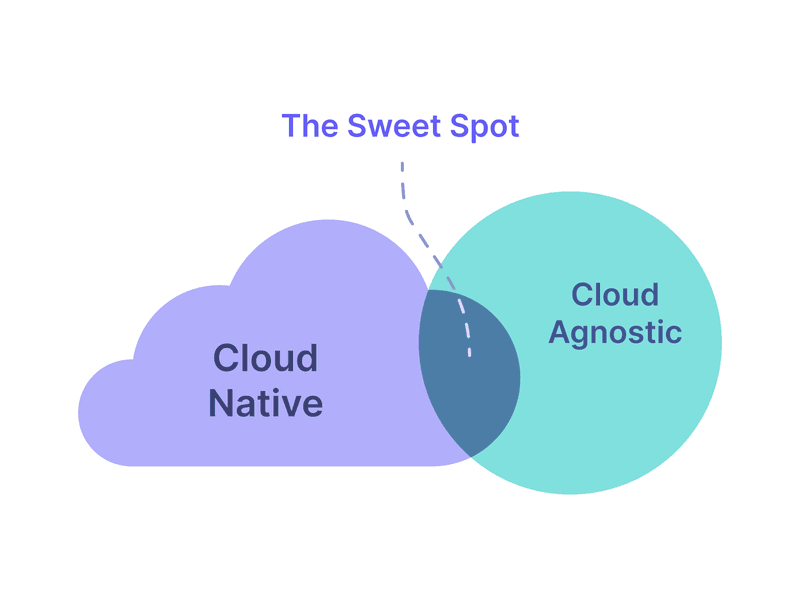
Some teams value this option so much that they give up cloud-native services and run the cloud like a traditional data center. That adds tooling, and the infrastructure gets expensive. The cloud was never meant to be run like a data center. The goal is the overlap: cloud-native where it helps, agnostic where it counts.
Why teams need the option
The reasons are rarely technical. They come from customers, markets and contracts:
- A SaaS company that handles sensitive data is asked by an enterprise prospect to deploy in the prospect's own cloud, or on its premises.
- You plan to serve a region where your cloud has no presence.
- Data residency laws require the data to stay in a country your cloud does not cover well.
- Another cloud vendor offers a better deal, or a service that makes one part of your product much easier.
Each of these is a sales or business decision. The engineering question is only how long it takes to say yes.
Capillary serves more than 250 brands, and its sales conversations often start with a request to run in a local region or a private cloud. Capillary reduced the effort to launch a new region from 64 person-weeks to 4 (a 93.75% reduction).
Why portability is hard
Moving an environment to another cloud fails for four common reasons:
- The documentation is out of date. The setup in production no longer matches what is written down, so the first weeks go to finding out what really runs.
- The automation is written per cloud. Scripts and Terraform for one cloud need rework for another, and the people who wrote them have often moved on.
- Each project has its own pipeline. Every pipeline must be rewritten and tested for the new cloud, and only a few experts can change them. If pipelines are too risky for developers, they are too risky for infrastructure agents, and they are just as hard to move.
- Environments drift apart. Staging, production and the new environment stop matching, and every difference becomes a bug in the move.
None of these is about the target cloud. They are about how the current setup is described and built.
Dev rules: blue cloud and gray cloud
For developers, the choice comes down to a simple decision model. We call it "blue cloud" and "gray cloud". Blue cloud services keep the option to move. Gray cloud services make a move harder, so you use them with care.
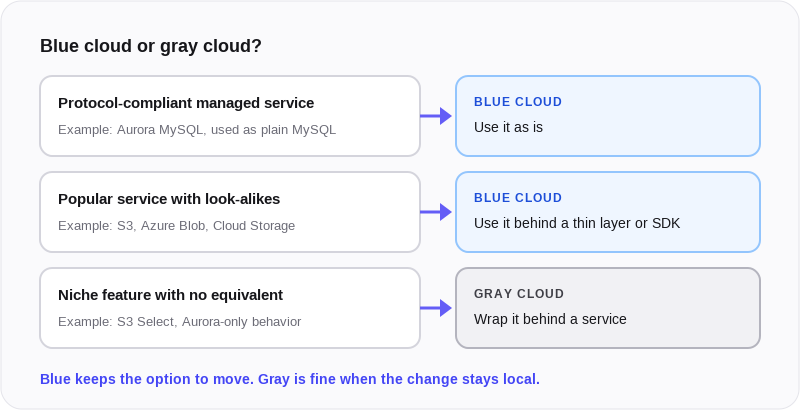
- Protocol-compliant managed services are blue. AWS Aurora MySQL is a good example. The application does not need to know whether it talks to Aurora or to MySQL on a plain virtual machine. It turns gray when the application depends on Aurora-only behavior: for example, if you design around the low latency of Aurora read replicas, or call the Aurora Data API.
- Popular services with look-alikes are blue, behind a thin layer. S3 is unique and widely used, and other clouds offer look-alikes such as Azure Blob and Google Cloud Storage. They offer similar features with different APIs. Use them, but do not build deep ties to one API. Build a thin utility layer for your own functions, or use a portable SDK such as MinIO.
- Niche features are gray. Some features have no equivalent elsewhere, such as S3 Select, which queries objects you already store in S3. They can save a lot of development time, so use them, but wrap them behind a service or a function. If you move, you write one more implementation of that service, and the change stays local instead of spreading through the codebase.
These rules are good practice even if you stay on one cloud forever.
Ops rules: one policy, an implementation per cloud
The ops side covers backup, recovery, code delivery, observability, security and high availability. Building all of it in a cloud-agnostic way is expensive. It is wiser to use the native capabilities of each cloud, and keep three rules:
- Keep the policy apart from the implementation. A disaster-recovery policy says which backups to keep and how often. It holds whether the database is Aurora MySQL or MySQL on a Linux server. Each cloud then implements the policy in the most reliable way it offers.
- Give developers one experience on every cloud. Collect metrics from every environment into one place, so dashboards and alerts work the same way whether a component is managed by the cloud or self-hosted.
- Keep the delivery workflow the same. Kubernetes is a first step toward being cloud-native and agnostic at once. But the way code reaches production must not change when the managed Kubernetes service underneath changes.
The first rule is the important one. A policy that does not care about the implementation is a contract. The next section shows the same idea applied to every building block.
The mechanism: one intent, a flavor per cloud
Most portability advice stops at the rules above. The hard part is keeping them true across hundreds of services and dozens of environments, change after change. That needs standards in contracts that a machine can check, and one declared model of the system in place of a pipeline per project.
In Facets, every building block is a module: Terraform with a contract that says what it needs, what it gives to other modules and which settings a developer can choose. A module has three parts to its name: an intent (what it provides), a flavor (how it is built) and a version, as in postgres/aws-rds/1.0. Core concepts explains each one.
The blueprint declares the intent: the orders service needs Postgres. The platform team writes a flavor per cloud with the same contract, such as aws-rds, gcp-cloudsql or kubeblocks. Facets wires the outputs of one module to the inputs of the next in each environment, so a service reads its database address the same way on every cloud.
The blueprint is one model of infrastructure, code and configuration (hyperconvergence), so it can rebuild a whole environment from one place. Developers and their AI assistants work with the same blueprint on every cloud, so the way they ship does not change. Modules and the catalog describes the contract.
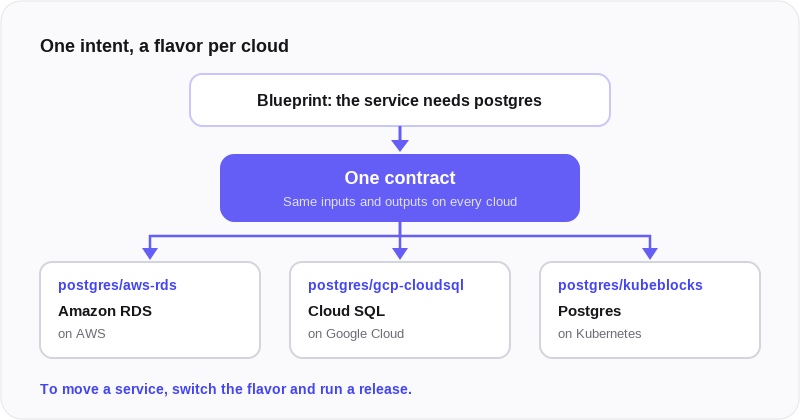
To move a service, you switch its flavor and run a release. MPL moved 130+ services from AWS to GCP this way, one group of services at a time, while feature work went on.
The same model covers the ops rules. A disaster-recovery copy or a new region is another environment from the same blueprint (backups and disaster recovery), so the blueprint stays the policy and each environment is an implementation. This is what makes environments a commodity: a new region, or the same environment on a different cloud, becomes a request instead of a project.
When the day comes, the move takes weeks
With the services behind contracts and the system in one blueprint, the move itself is mostly volume. An infrastructure agent scans the source, writes the target as a blueprint and builds it in a loop of plan, validate, policy and apply. People approve the risky steps, such as the data copy and the cutover.
Spectrum consolidated its AWS and Azure workloads onto Google Cloud with Facets. Spectrum moved its Azure event processing to Google Cloud in two weeks with no customer impact; the AWS backend followed in 90 days.
Read how a platform-led migration runs, phase by phase, and see cloud migration for how Facets runs these moves. For the cost side of the same choice, see being at a striking distance from cloud optionality.
Keeping the option to move is a property of how the system is declared. Why Facets explains the idea.