


Cloud migration has traditionally been treated as a consulting-heavy exercise: workshops, spreadsheets, architecture diagrams, custom scripts, and months of coordination between infrastructure, DevOps, and application teams.
That approach worked when environments were smaller and simpler. Today, enterprise systems are far too complex for migrations to depend entirely on manual effort and tribal knowledge.
Automation in cloud migration today exists on a spectrum.
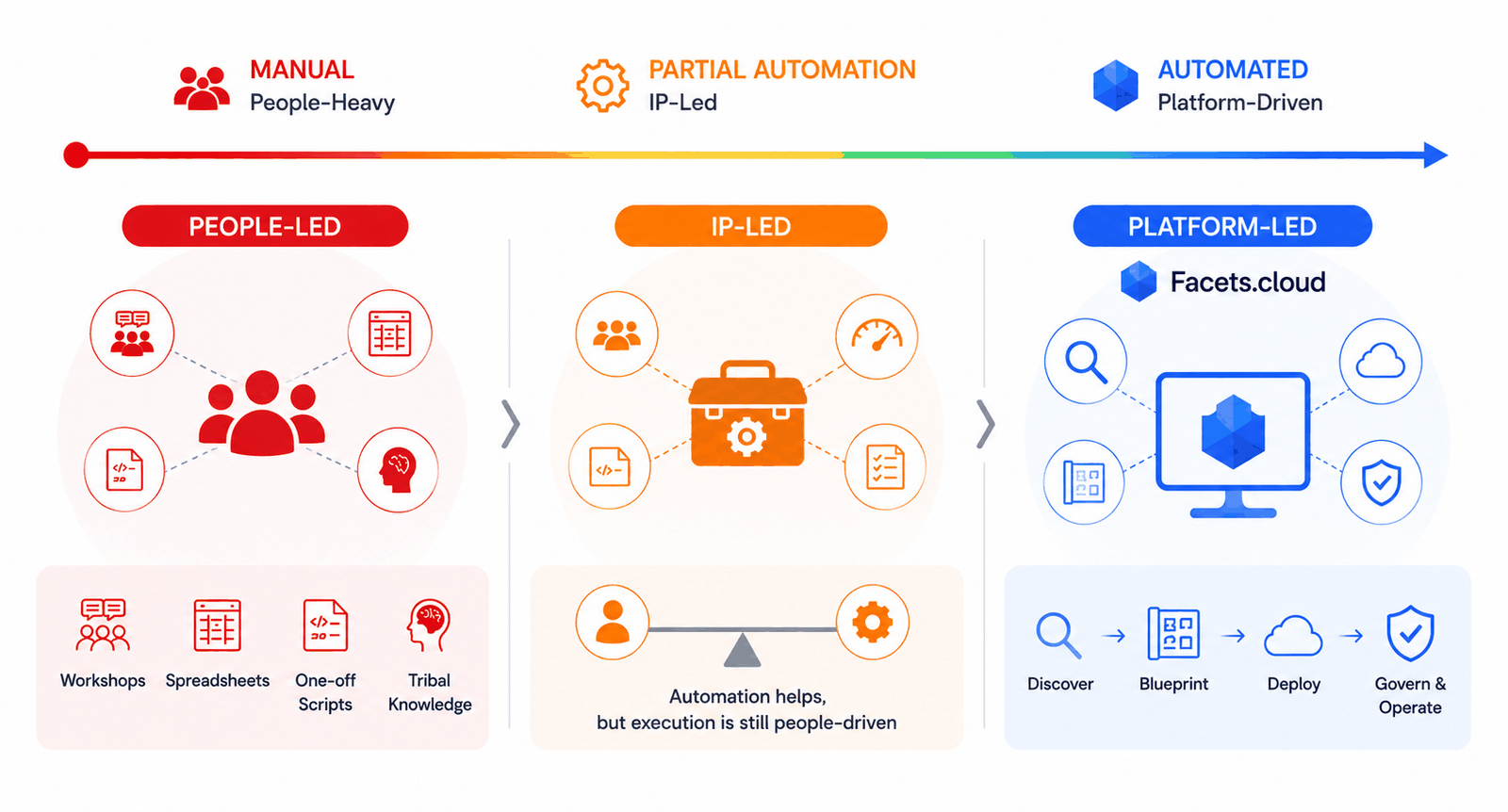
At one end are people-led migrations that rely heavily on consultants, manual discovery, workshops, one-off scripts, and institutional knowledge to move workloads to the cloud.
In the middle are modern consulting firms that position themselves as IP-led. These firms use internal automation tools and accelerators to speed up parts of the migration process, but the overall execution still remains heavily dependent on services teams and manual coordination.
At the other end is a fully platform-led migration approach, where the platform itself drives discovery, blueprinting, environment creation, governance, and operations through standardized workflows.
This is exactly the approach Facets.cloud takes.
Facets replaces fragmented manual migration work with an automated, platform-driven workflow. AI agents handle discovery, systems are mapped into cloud-agnostic blueprints, and environments are recreated through repeatable workflows rather than bespoke engineering projects.
Cloud migration can broadly be broken into three critical phases:
- Assessment & Discovery
- Implementation & Landing Zone Creation
- Handover & Go-Live
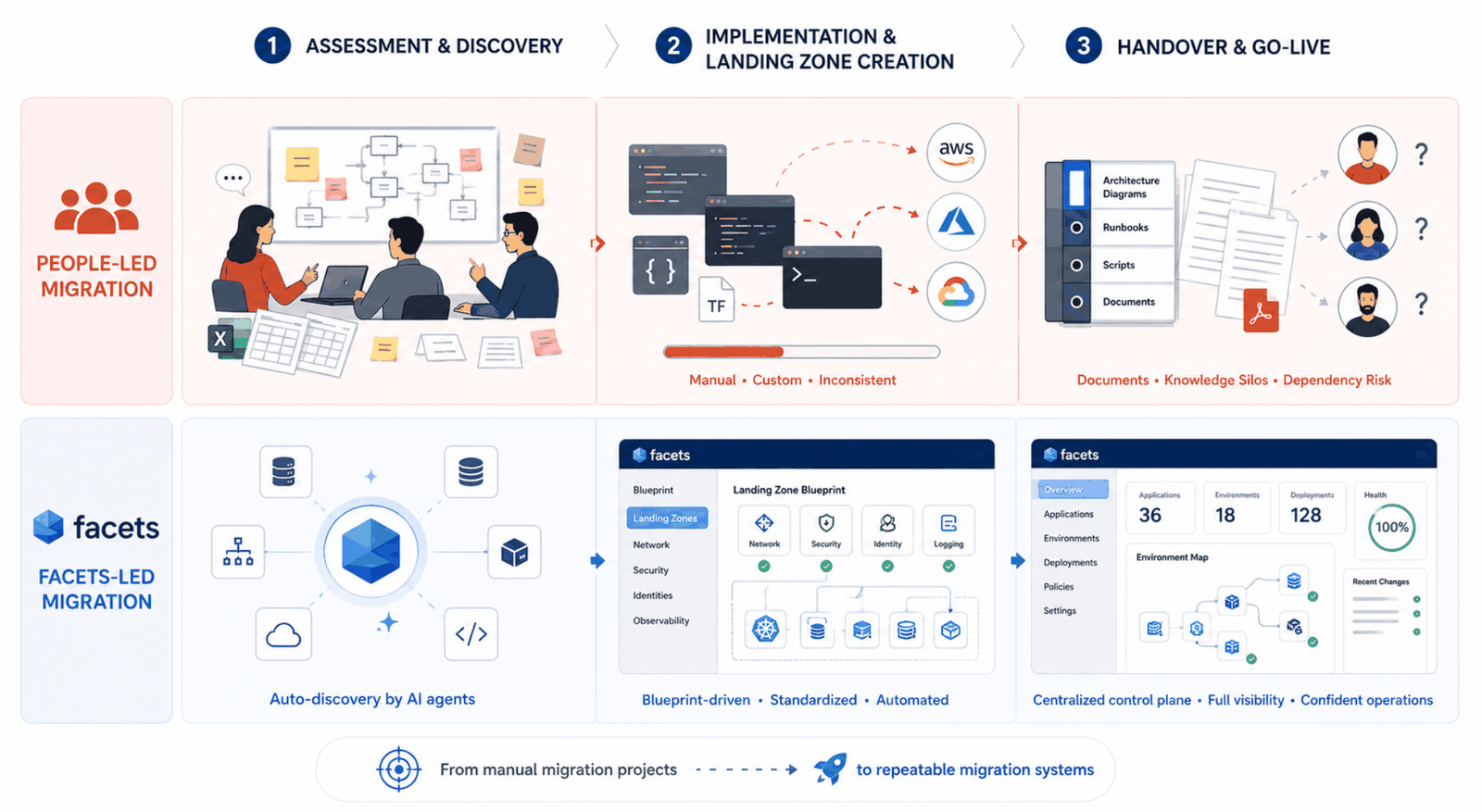
The difference between people-led and product-led migration becomes clear in how these three phases are executed.
Assessment & Discovery
People-Led
People-led migrations rely heavily on workshops, interviews, spreadsheets, and existing documentation to understand the environment. Discovery is typically done on a resource or workload basis — databases, VMs, clusters, or individual services are assessed separately, and architects manually piece together how the system works.
The challenge is that enterprise environments are rarely documented accurately. Hidden dependencies, deployment flows, and environment differences are often discovered later during implementation, causing delays and rework.
Facets-Led
Facets combines stakeholder workshops with AI-driven discovery to build a complete view of the application infrastructure upfront. Instead of discovering isolated resources, our AI agents discover infrastructure, services, dependencies, configurations, and runtime relationships as part of the application's working model.
This discovery is converted into a structured, cloud-agnostic blueprint that captures how the application actually operates, not just where individual resources exist. Teams then validate and enrich the findings, creating a reliable foundation for migration planning while significantly reducing manual effort and rework.
Implementation & Landing Zone Creation
People-Led
Implementation typically involves custom scripts, manual Terraform, Kubernetes manifests, CI/CD modifications, and one-off automation. Every migration becomes its own engineering project.
As new dependencies surface, environments require rework, standards drift across teams, and migrations become difficult to scale.
Facets-Led
The discovered blueprint is transformed into deployable infrastructure and landing zones using reusable workflows and standardized templates for networking, security, deployments, observability, and policies.
Instead of rebuilding environments manually every time, teams can create repeatable, governed environments across clouds and stages.
Handover & Go-Live
People-Led
In most people-led migrations, handover means documentation, KT sessions, and operational runbooks. Over time, those documents become outdated, and critical knowledge leaves with the migration team.
The customer receives the infrastructure, but not necessarily a clear operating model.
Facets-Led
With Facets, the blueprint remains the source of truth even after migration is complete. Teams get visibility into environments, deployments, dependencies, and changes through a centralized control plane.
This makes post-migration operations better defined, reduces dependency on consultants, and gives internal teams confidence to manage and evolve the environment independently.
The Impact of a Facets-Led Migration
The impact of a Facets-led migration is visible not just in faster execution, but in better operational outcomes.
By replacing fragmented manual processes with AI-driven discovery, reusable blueprints, and standardized workflows, Facets helps organizations:
- Complete migrations in 45 days that would otherwise take 180+ days with traditional service-led approaches
- Reduce migration effort by up to 75% through reuse and automation
- Achieve near-zero downtime even for complex environments
Cloud migration should not feel like rebuilding systems from memory every time.
With Facets, migration becomes faster, repeatable, and operationally sustainable, from discovery to go-live and beyond. See how Facets approaches cloud migration end to end.