


Ask three engineers how a production system fits together and you get three answers. One reads the Terraform. One reads the pipeline. One remembers a decision from last year that nobody wrote down.
The facts about a software product (its services, dependencies, infrastructure, policies and configuration) are spread across documents, tickets, custom scripts, pipeline files and IaC repositories. Each source is right about its own part. None of them describes the whole system, and none of them is checked against what actually runs.
An infrastructure blueprint fixes that. It is one declared model of the system that people and machines read and change.
The system in production is not in the code
Architecture diagrams and design documents were the first attempt at a single source of truth. They fail in three familiar ways:
- They go stale. The system changes every week, and the document changes when someone has time.
- They hold tribal knowledge. Much of the system is known to a few people, and that knowledge leaves when they do.
- Teams reinvent the wheel. One team solves a problem that another team solved last quarter, because nothing shows the shared parts.
Picture a new product that needs a few microservices and a MySQL database with backups, read replicas and tuned settings. Teams usually move through three stages:
- Ops by request. Developers file a ticket. The ops team reads it, runs some scripts and a few manual steps, and the database appears. The architecture document is not updated, and each environment ends up a little different.
- A shared document. Developers write their needs into the architecture document, and ops provisions from it. The document stays current, but the scripts and manual steps still produce inconsistent environments.
- The model drives deployment. Developers declare what they need in the model, and the platform provisions it. The document cannot go stale, because it is the thing that runs.
The third stage now has a fourth step. People and infrastructure agents both change the desired state in the model, and the platform plans, checks and releases each change.
Why AI made a declared model urgent
A pipeline tells a machine how. A blueprint tells it what.
An AI assistant can read a repository and write a feature in an afternoon. To ship that feature, it needs facts that are not in the repository: which database the service uses, which services depend on it, and what runs in each environment. Without a model, the agent guesses, and a wrong guess becomes a wrong change.
A pipeline does not help. It records the steps for one project, in a fixed order, and it runs with privileged access. An agent that must learn every pipeline before it can make a change will either stop or guess.
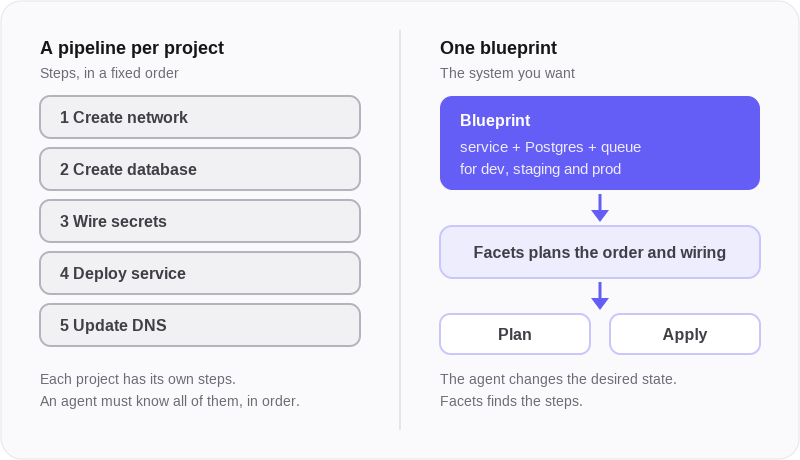
With a blueprint, the agent and the engineer start from the same facts. They declare what should exist, such as "the orders service uses a Postgres database", and the platform works out the order and the wiring.
What a blueprint holds
Think of a blueprint as the plan for a house: you agree on the design and the parts before construction begins, and the builders work from the plan. An infrastructure blueprint describes:
- Resources: services, databases, caches, queues, cloud-native resources, scheduled jobs and one-time jobs, stateless or stateful.
- Relationships: which resource depends on which, and how their outputs connect to inputs.
- Shared declarations: anything with a Terraform provider can be a resource, such as dashboards, alerts and backups.
Each service sits in the model with the code it runs, its configuration and the infrastructure it uses. We call this the hyperconvergence of infrastructure, code and configuration. One change to the model can touch all three, and the plan shows all three.
Each resource is an intent, such as a database, pinned to a flavor that says how it is built, such as a managed Postgres on AWS. The flavor comes from a module that the platform team owns, with a contract that says what a developer may set. Teams pick modules from the catalog, so they describe what they need without reading the Terraform underneath.
The blueprint itself is plain JSON in Git: one file per resource, with its settings, its metadata and its dependencies.
From one blueprint to every environment
Every environment, from production to a short-lived environment for one branch, is built from the same blueprint.
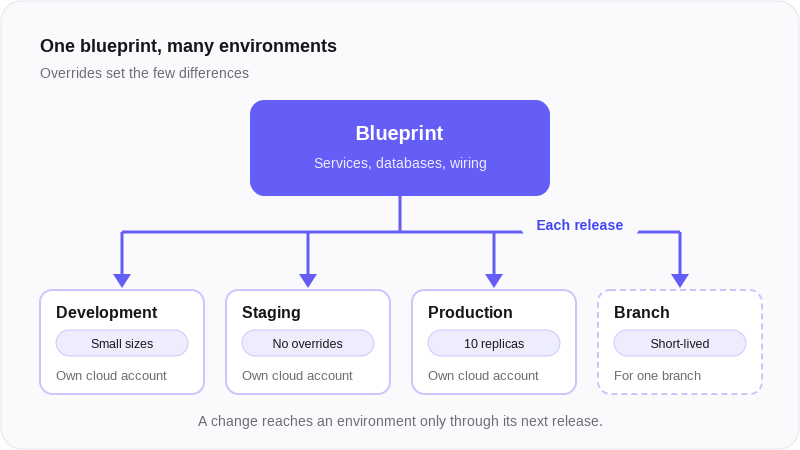
Facets generates each environment's Terraform from the blueprint and keeps that environment's state. Where an environment should differ, you set an override on it, such as 10 replicas in production only. Everything else follows the blueprint, so staging and production differ only in the ways you chose. Each environment can deploy to its own cloud account, so development and production can run in separate AWS accounts or GCP projects from one model.
The wiring is generated too. The outputs of one module connect to the inputs of the next in each environment, so nobody copies a database host from Terraform into a Helm values file.
Nothing in a running environment changes when the blueprint changes. A change reaches an environment only through a release, and the release shows its Terraform plan first. Environments and releases covers overrides in detail.
This also removes the pipeline per project. Your CI still builds and tests the code, and the blueprint says where each image runs. Why you should use IaC to deploy your applications makes the case for putting the application into the same model.
Blueprints in Git
A blueprint lives in a Git repository, so it gets the workflow your teams already trust:
- Every edit is a commit. Each change in the Blueprint Designer produces a Git commit, so the history shows what changed and who changed it.
- Branches and pull requests. Work on a feature branch, open a pull request and review the change like application code.
- Sync after merge. When a pull request merges, a webhook syncs the blueprint in Facets. The change then waits for the next release, which you, a schedule or your CI start.
- Rollback per resource. Each resource can go back to an earlier release, through a plan you review first. A rollback restores settings, not the data inside a database.
Git as the source of truth lists each step. For running this at scale, see Implementing GitOps at scale.
Seeing the model
A model helps only if people can read it. The Blueprint Designer shows the blueprint as an interactive graph: resources are nodes and dependencies are edges. A table view lists the same resources for teams that prefer to scan. You can add and connect resources, switch branches and commit, all from the browser.
The Designer shows the desired state: what should exist. Each environment's overrides sit beside it, and in JSON mode you can compare the blueprint with an environment's override to see exactly what differs. Overrides keep a version history, so you can see a past revision and roll it back.
Agents read the same model. Praxis can also review a blueprint and report what to fix, such as plaintext secrets, hard-coded account IDs or overrides that repeat the base values (Review a blueprint's hygiene).
How Facets does it
In Facets, the blueprint is the one model of the whole system. People and AI assistants, such as Claude Code, Codex or Cursor through the Praxis CLI, change the desired state in it. If the system already runs, Praxis can build the first blueprint from your cloud account with read-only access.
Module contracts check every input. Each release generates the Terraform, shows the plan and passes guardrail policies and approvals before it changes your cloud. Only the Facets orchestrator runs the release and holds the cloud keys. How Facets works shows the model in detail.
One model also gives every team the same picture of the system. Capillary reduced the effort to launch a new region from 64 person-weeks to 4 (a 93.75% reduction) (case study). Piyush K, CTO of Capillary Technologies, said:
Facets standardized our build, deploy, monitor, and metrics. Now everyone speaks the same language and understands all services.
"
Declaration is the second of three things that close the loop for delivery in the AI era, after contracts. Infrastructure orchestration shows how the parts fit together.
Why Facets explains why delivery needs a declared model now. To see a blueprint built from your own stack, book a demo.