


The best software release management tools in 2026 fall into three lanes: orchestration platforms (Facets, Harness, Octopus Deploy, CloudBees, Digital.ai), SCM/CI and deployment engines that coexist (GitLab, GitHub Actions Environments, Argo CD), and governance or feature-flag layers (ServiceNow, LaunchDarkly, Unleash). Facets releases infrastructure, code, and config as one unit.
Start with a definition, because most release management tooling quietly assumes the wrong one. The default model treats a release as a CODE release: ship a new binary onto infrastructure that is presumed stable and already provisioned. Modern systems are not that simple. The thing you actually want to move from one environment to the next is a desired-state change that spans application code, the infrastructure it runs on, AND the configuration that wires them together. A release is better understood as a coherent mutation: you take a known desired state, mutate it, and propagate that exact change, as-is, from one environment to the next, with all three layers traveling together.
That definition explains where the hard part lives. It is rarely the deploy command itself. It is the failure modes that show up at the seams when the three layers move out of step: a partial deploy that ships the application but not the database migration it depends on, a config change applied in staging but never promoted to production, a rollback that restores the old binary onto infrastructure that has already drifted, or a release that clears every pipeline gate yet leaves no audit record a regulator will accept. Progressive delivery of EVERYTHING, not just app code, is what closes those seams. The right tool depends on which of those seams actually hurt you. This article examines the ten best options in 2026, grouped by what each one actually does, so you can pick the right tool for the right lane.
Three lanes run through the whole list. Orchestration platforms execute the release end to end and sequence work across services and environments. SCM and CI engines own the code, the pipelines, and the gates, and coexist with an orchestrator on top. Governance and feature-flag layers control change records and runtime behavior, and also coexist rather than compete. Every tool below is mapped to one of those three lanes, and that is the only taxonomy this article uses.
How We Chose the 2026 List
Every tool below meets four criteria: it is in-category and actively maintained in 2026; it executes or governs releases rather than only planning or tracking them; it has real 2026 mindshare; and it earns a clear lane label (alternative, compare, or coexist with Facets). Those criteria are why four names from the older version of this list dropped out. See "What We Removed and Why" at the end for the specifics.
When you evaluate any tool below, the sharpest question to ask is how much of a release it treats as one promotable unit. A tool that only moves application code assumes the infrastructure and configuration underneath are already correct and in sync, which pushes the seam-level failures back onto you. So the criteria that matter most are: does it diff and apply a single desired state across code, infrastructure, AND config together, or only the app layer; does it promote that exact change as-is across environments rather than re-running steps by hand; can it limit the blast radius to the resources you intend to touch; does a plan gate force a preview before anything changes; is rollback a known prior state rather than a reconstructed one; and does it leave the audit trail a regulator will accept. The further a tool sits from "everything moves as one coherent mutation," the more glue you supply yourself.
10 Best Software Release Management Tools in 2026
1. Facets.cloud
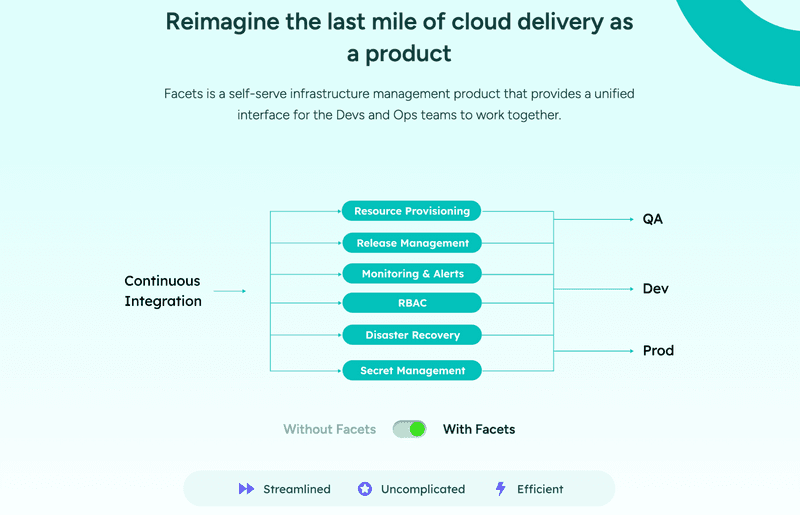
Facets is an AI-native SDLC orchestrator and Internal Developer Platform built around the coherent-mutation definition of a release: it releases infrastructure, application code, and configuration as one unit. Where most tools on this list deploy an application onto infrastructure that someone else provisioned, Facets treats the release as a single Terraform deployment that diffs a declarative blueprint against current state and creates, updates, or deletes infrastructure, configuration, and applications in one unified release orchestration pipeline. It stops at a mandatory plan gate before anything changes: the hard rule is always plan before release, and for any production target or several new resources at once, Facets plans first by default.
That model produces a few things that pure deploy tools cannot. A release can be scoped with selective --target operations so the blast radius is limited to the resources you intend to touch, so a CI image update redeploys only the changed services instead of triggering a full-environment release. Changes are promoted across environments through release streams: environments bind to a stream, the orchestrator detects the change-set (new build, infra, or config), generates the Terraform to sync it, and promotes that exact change to higher environments with dependency resolution rather than re-running steps by hand. Rollback is a first-class operation because the previous blueprint state is known, not reconstructed. Approval workflows gate promotion with maker/checker controls and a complete audit trail (who triggered which release, when) backed by transparent Terraform logs, which is the record regulated teams need. Because infrastructure and config travel with the code, drift is prevented by design through 100% IaC-driven operations and real-time drift detection rather than reconciled after the fact. Praxis, the AI Platform Engineer, turns an instruction like "deploy to production" into a risk-assessed, dependency-ordered release: it interprets intent, assesses blast radius and reversibility, computes deployment order, and never auto-approves a destroy or a prod deploy without explicit confirmation.
The platform is also extensible enough to give teams the advantages of both bought and custom-built IDPs without maintaining a platform team's worth of glue code.
The evidence is in the customer numbers. Teams on Facets have shipped 25x, cut operations tickets by 95%, and reduced production issues by 70%.
Honest limitation: Facets is not a pure-play release or deploy tool. Teams that only want pipeline approvals or a feature-flag service will find it broader and heavier than they need. Its value shows up when infrastructure, code, and config genuinely need to move together.
Book a demo with Facets to see a release run end to end.
2. Harness
Harness is purpose-built release orchestration for multi-team, multi-service sequencing, and it is arguably the strongest direct release-orchestration rival in 2026. Its Continuous Delivery and Release Orchestration modules handle progressive delivery (canary, blue-green), GitOps, and AI-assisted continuous verification that watches deployment health signals and triggers intelligent automated rollback when metrics regress. For organizations coordinating dozens of services across many teams, the sequencing and verification story is genuinely deep.
Concede: enterprise pricing and module sprawl are real friction, and the platform is focused on application and service delivery rather than provisioning the underlying infrastructure the way an IDP does. If your release is "ship this service," Harness is excellent. If your release is "ship this service plus the database, queue, and network changes it depends on," you are stitching that together yourself. See a full breakdown at how Facets compares to Harness.
3. Octopus Deploy
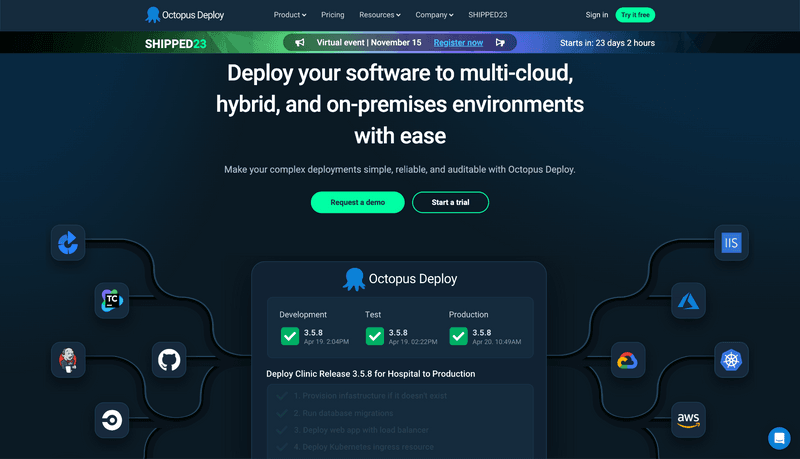
Octopus Deploy is mature, opinionated deployment orchestration with a deep heritage in heterogeneous environments. It promotes releases across environments with reusable pipelines, runbooks for operational tasks, clear RBAC, strong audit trails, and ITSM integrations. Its cloud-native and Kubernetes support has caught up while it kept the legacy-target breadth that newer tools never built.
Concede: Octopus is deeper than Facets on raw deployment-target breadth and legacy-application support, and that is a legitimate reason to choose it. It is deploy and release focused, so it is weak on earlier development stages and offers no IDP layer, and the cloud platform-fee model gets expensive at high deployment concurrency.
4. CloudBees
CloudBees offers end-to-end CI plus release orchestration plus feature management plus compliance and analytics, with strong governance and role-based controls. Its most credible pitch is the Jenkins-modernization path: organizations sitting on sprawling Jenkins estates can move to managed, governed pipelines without abandoning what they know.
Concede: the suite carries enterprise weight and cost, the product set was assembled partly through acquisition and can feel less unified than a single-architecture platform, and it is not an infrastructure or IDP layer. You are governing application delivery, not provisioning the stack underneath it.
5. Digital.ai Release
Digital.ai Release is built for large, complex, regulated enterprise releases that require heavy cross-team coordination. It is strong on audit and logging, offers AI-assisted release analytics, and integrates tightly with Jira for planning-to-release traceability. For a bank or insurer orchestrating a release train across many teams and change windows, it is a serious option.
Concede: it is a heavyweight platform with comparatively low broad-market mindshare, and getting full value usually means adopting the broader Digital.ai suite, which is a significant investment. It earns its spot on enterprise fit, not on momentum.
6. GitLab
GitLab delivers end-to-end DevSecOps on a single platform: native CI/CD, environments, feature flags, DORA metrics, and strong compliance tooling. It belongs in the coexist lane rather than as a head-to-head alternative, because many Facets users already run GitLab as their SCM and CI and simply let Facets orchestrate the release on top.
Concede: the consolidated-platform learning curve is real, multi-team release orchestration is less specialized than what Harness or Octopus offer, and GitLab is not an infrastructure or IDP layer. As a place to host code, run pipelines, and track DORA, it is excellent, and it pairs cleanly with a dedicated orchestrator.
7. GitHub Actions Environments
GitHub Actions Environments is the default release-gating layer for the enormous population of teams already on GitHub. Environments give you native manual-approval gates, wait timers, branch and secret scoping, self-review prevention, and custom protection rules through GitHub Apps, and the 2026 security defaults have improved meaningfully.
Concede: these are approval and gate primitives, not orchestration. There is no multi-service sequencing, no infrastructure orchestration, no feature flags, and no DORA dashboards out of the box. For a single repo shipping to a few environments it is more than enough; beyond that you graduate to a dedicated orchestrator and keep Environments as the gate. It coexists rather than competes.
8. Argo CD
Argo CD is CNCF-graduated and the de facto GitOps engine for Kubernetes. It continuously reconciles declarative desired state from Git, self-heals drift, makes rollback trivial because the desired state is versioned, and supports multi-cluster topologies with native Helm and Kustomize.
Concede: Argo CD is Kubernetes-only and has no native multi-team governance, ITSM integration, or non-Kubernetes targets, and promotion logic across environments has to be assembled around it (often with Argo Rollouts or external tooling). It is the right engine for the Kubernetes layer of a release and the wrong place to look for organization-wide release governance. It coexists with an orchestrator that owns the broader release.
9. LaunchDarkly
LaunchDarkly is the best-in-class feature-management layer: precise targeting, progressive and canary rollouts decoupled from deployment, instant kill switches, and experimentation, backed by broad SDK coverage and a strong mean-time-to-recovery story. Its 2026 expansion into AI config and agent control extends flag-style governance to model behavior.
Concede: this is a feature-flag layer, not a release orchestrator. Commercial pricing scales with seats and contexts, and flag-debt governance is on your team. The healthy pattern is to keep LaunchDarkly as the runtime-control layer and let an orchestrator handle the release that ships the code behind those flags.
A note on the open-source alternative in this lane: Unleash covers much of the same ground with a mature open-source core, a self-hosted and air-gapped option, broad SDK breadth, progressive rollouts, kill switches, targeting, and enterprise SSO, audit, and change-request support in its paid tier. Concede the same scope limit (feature flags only) plus self-hosting overhead, with the most advanced governance gated behind the paid tier. Either way, the flag layer coexists with your release orchestration.
10. ServiceNow DevOps Change Velocity
ServiceNow DevOps Change Velocity brings out-of-the-box change-request automation and policy-driven auto-approvals to teams that already run ServiceNow ITSM. It ingests real pipeline signals to risk-score changes and can auto-approve low-risk ones, which is a strong fit for regulated enterprises that must tie every deployment to a change record.
Concede: it requires meaningful ServiceNow investment, and it governs and approves changes rather than executing the deployment itself. For smaller teams it is overkill. It coexists as the change system of record while an orchestrator does the actual release.
Also Read: 10 Best Cloud Infrastructure Automation Tools
Also Read: 7 Best Internal Developer Platforms (IDPs)
What We Removed and Why
The earlier version of this list aged, and a few entries no longer belong in a release management roundup:
- Jenkins Release Plugin is a CI-build helper, not release management, and Jenkins is increasingly what teams migrate away from rather than toward. Its slot is better filled by GitHub Actions Environments for gating and Harness for orchestration.
- Jira is a planning and tracking tool, not release execution. Including it muddied the category; it integrates with the tools above but does not release anything.
- Chef (Progress Chef) is configuration management, a different category, and the open-source Infra Server is heading to end of life in 2026.
- Plutora is a value-stream-management and visibility dashboard, not release execution. Digital.ai better represents the analytics-heavy enterprise niche, so the value-stream dashboard slot did not earn a place in an execution-focused list.
Where Facets Fits
Facets vs Octopus Deploy: the verdict
Choose Facets when a release is a coherent mutation of code, infrastructure, and configuration that has to propagate as one promotable, drift-free unit across environments, with a mandatory plan gate, self-service environments, and an AI Platform Engineer, rather than just application or service pipeline orchestration on infrastructure someone else keeps in sync; choose a pure deployment tool like Octopus Deploy when you want broad heritage and hybrid target coverage with no IDP layer; and keep GitLab or GitHub Actions Environments as your SCM, CI, and gates, Argo CD as your Kubernetes GitOps engine, LaunchDarkly or Unleash as your feature-flag layer, and ServiceNow as your change system of record, because Facets orchestrates the release across all of them rather than competing with each.
Aggregate results back this up across the customer base: a 80% in operational toil and 8-25x in delivery speed.
Ready to Pick a Lane?
The choice usually comes down to which seam hurts most, and that traces back to the definition you started with. If you can honestly treat a release as just a code release, because the infrastructure and configuration underneath are already stable and in sync, the deploy-focused and coexist-lane tools above are a fine fit. If, like most modern systems, your release is really a coherent mutation where application and config drift apart from the infrastructure they run on, you need an orchestrator that diffs and ships all three as one promotable unit, and that is where Facets fits. If your releases already move as one and you only need stronger gates, an audit trail a regulator accepts, or runtime flag control, the coexist-lane tools slot in alongside what you have.
Book a demo with Facets to see a release run end to end across infrastructure, code, and configuration.