


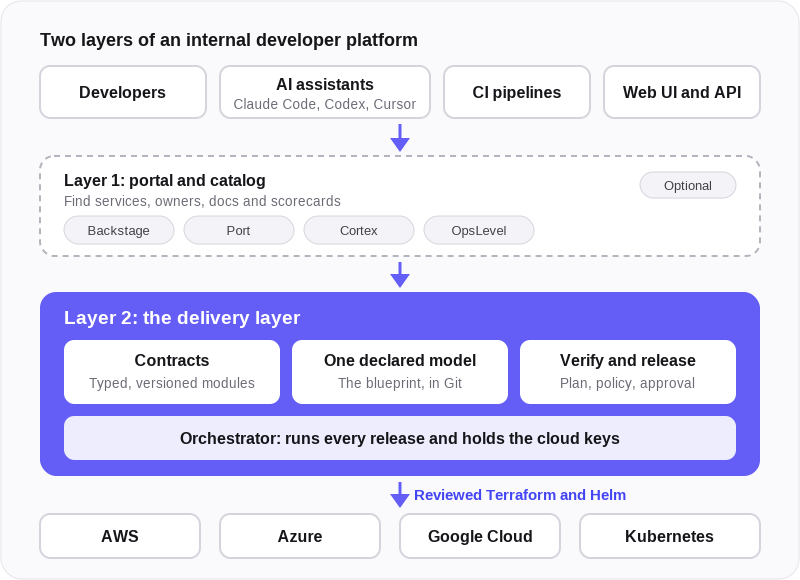
An internal developer platform (IDP) gives developers self-service access to environments, infrastructure, and deployments behind standardized guardrails. The strongest 2026 internal developer platforms split into two layers: provisioning and orchestration engines that build real infrastructure (Facets, Humanitec, Qovery, Appvia Wayfinder, Mia-Platform) and developer portals that catalog and govern it (Backstage, Port, Cortex, OpsLevel).
The defining shift in 2026 is that an IDP now has to be AI-operable as well as developer-operable. Self-service now serves two audiences: the developers who file fewer tickets, and the AI agents those developers delegate to. An agent needs a platform it can read, reason about and safely act on through a programmatic surface. A dashboard it has to click through does not help it. Portals and catalogs stay useful for discovery. The harder question is what sits under them. If the portal sits on the same per-project pipelines, the privileged access stays underneath, and an agent has nothing to check its work against. The portal layer still earns its place where the genuine gap is visibility and governance over an estate you already provision. It just stops being the whole story.
Most teams reaching for an IDP are trying to solve the same tension. Developers want to ship without filing infrastructure tickets, while platform and security teams need consistency, compliance, and cost control. The two layers above answer different halves of that tension. An orchestrator decides what infrastructure exists and enforces how it is provisioned across environments. A developer portal makes the resulting estate visible, scored, and governed. Picking the right tool starts with knowing which half is actually your bottleneck, and increasingly with knowing whether that half is one an AI agent can operate on your behalf. If environment consistency is your real problem, see environments as a commodity.
What an IDP actually changes
The point of an IDP is to move infrastructure decisions out of the ticket queue and into a path developers can take themselves, without removing the controls platform and security teams depend on. Concretely, that shows up in a few mechanisms.
A self-service path replaces the ticket round-trip. Instead of a developer opening a request, waiting for a platform engineer to hand-write a database, a queue, and the IAM bindings between them, the developer picks from a paved road: a pre-approved building block where the IAM policy, network placement, and tagging are already decided. The cognitive load that disappears is real (knowing which subnet, which role, which encryption setting) because someone encoded the right answer once.
Guardrails are applied by default rather than after an incident. Role-based access control, maker/checker approval gates, and policy checks run on the provisioning path itself, so a non-compliant resource is rejected before it exists rather than flagged in an audit weeks later.
A declared state makes drift visible. When a resource is changed out of band (a console click, a one-off patch), the platform needs a record of what should exist to compare against. Changes made outside the platform show up the next time a release runs with a refresh, and a normal release brings the environment back to its declared state. That is the difference between "we think production matches staging" and knowing it does.
Cost and resilience follow from consistency. Reproducible environments make idle non-production spend visible because every environment is built the same way and can be torn down the same way, and they make failover and rollback predictable because there are no snowflake configurations to surprise you.
There is one more mechanism that matters more every quarter: the provisioning path is becoming the surface AI agents act on. When the self-service path is a structured, declarative contract, an agent can plan a change against it, reason about blast radius, and apply it under the same guardrails a human would, because the rules live on the path and not in a person's head. A UI workflow gives the agent nothing to plan against.
The caveat is that an IDP is not free leverage. It is a system you adopt and operate, and the wrong layer for your problem adds friction instead of removing it. That is why selection matters.
The IDP, reimagined for AI agents
Platform engineering was the right idea. Self-service, standards, golden paths and less toil are still the goals.
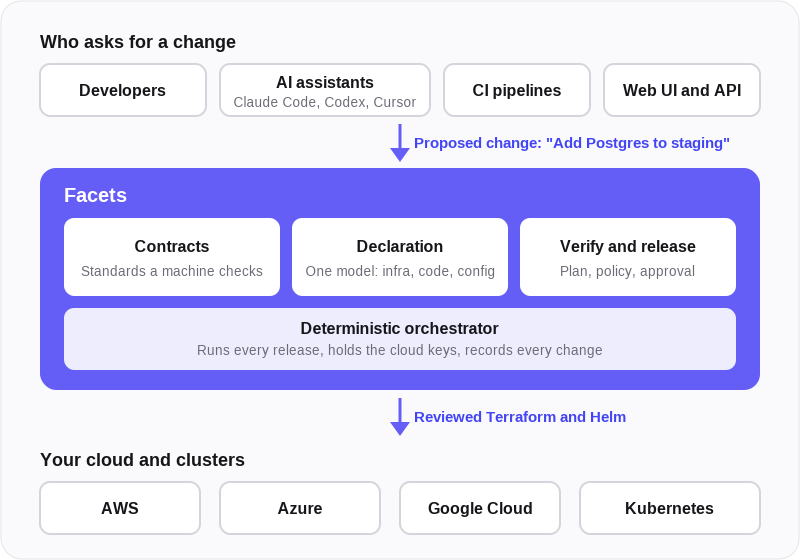
AI changed the volume and who sends the change. A coding assistant writes a feature in an afternoon, and then the pull request waits for an environment, a pipeline change or someone with production access. Agents now send changes too. They cannot file a ticket and wait, and they need a way to check their work before it reaches the cloud. In code, compilers and tests do that check. In delivery, only people do. So the IDP keeps its goals and changes its mechanism:
| The IDP as built so far | The IDP, reimagined for the AI era |
|---|---|
| Serves developers through a portal | Serves developers and their AI assistants and agents, through any client (UI, CLI, assistant, API) |
| Golden paths as templates you copy once | Golden paths as versioned module contracts a machine checks on every change |
| A portal on top of per-project pipelines | One declared model (the blueprint); the orchestrator plans and releases; no pipeline per project |
| Standards in docs and review comments | Standards inside modules and guardrail policies |
| Platform team fields tickets | Platform team writes the rules; everyone ships inside them |
| Built and run in-house by a platform team | Built on Terraform the team already knows; the hard parts come with the platform |
The portal does not go away in this picture. It moves up a level, and the delivery layer under it does the checking. Build on what engineers already trust explains why that layer should be built on Terraform.
How to choose
The goal of an IDP is to reduce the friction that developers, and the agents working alongside them, face. It should not add another layer of process. Evaluate candidates against six criteria, and read each one through the two-layer split: are you trying to provision and orchestrate infrastructure, or to catalog and govern what you already provision? If you are still deciding whether to build that layer yourself, read what building an internal developer platform really takes first.
Scalability
The platform should grow with you across teams, environments, and clouds without forcing a rewrite. Ask whether it handles multi-environment and multi-cloud estates natively, or whether scale is something you bolt on later.
Integration
An IDP lives in the middle of your toolchain. It should extend your existing CI, observability, secrets, and cloud accounts rather than replacing them. The best tools meet your stack where it is instead of demanding you rebuild around their opinions.
Ease of use
Self-service only works if developers can use it without reading a manual. Weigh the day-one developer experience against the day-one platform-team setup cost, because those two are often in tension.
Security and governance
Role-based access control, approval workflows, audit trails, and policy enforcement should be first-class from day one. A platform that simplifies provisioning while weakening governance is a poor trade.
Cost
Account for both the license or SaaS per-seat cost and the operational cost in platform-engineering time. A "free" framework you build and maintain yourself can be the most expensive option once you price in the people who run it.
AI-operability
Ask whether an AI agent can actually operate the platform, or only read from it. Three concrete tests separate the two:
- Contracts a machine can check. Standards live in modules with typed inputs and outputs, and the modules are versioned. A wrong value fails the check before anything changes.
- One declared model. The whole system (services, databases, queues and how they connect) lives in one model, with no pipeline per project. The agent changes the model, and the platform works out the steps.
- A verify and release step. Every change shows a plan and passes guardrail policies and approval rules before it applies. Only the orchestrator holds the cloud keys, and the agent acts with the permissions of the person who uses it.
This is the criterion that most cleanly separates a provisioning-and-orchestration engine from a portal that sits on top of one.
The platforms, by layer
The list below is organized into the two layers introduced above. Provisioning and orchestration IDPs build and manage real infrastructure. Developer portals and governance layers catalog, score, and govern services but do not provision infrastructure, so they coexist with an orchestrator rather than replace it. Each entry follows the same pattern: capabilities, benefits, the limitation worth knowing, and an explicit note on where the tool sits relative to Facets.
One note on scope: earlier editions of this list included Portainer, but it is a container and Kubernetes management tool. It does not provision multi-environment infrastructure from a self-service blueprint or act as a developer portal, so we dropped it and added the portal layer (Backstage, Port, Cortex, OpsLevel) the category now expects.
Provisioning and orchestration IDPs
These tools build and manage actual infrastructure. They decide what exists, provision it across environments, and enforce how it stays consistent.
Facets
Facets is the infrastructure delivery platform for developers and their AI assistants: the IDP, reimagined as the delivery layer under your portal. The model is a blueprint: a declarative description of an application and the resources it depends on (its services, datastores, queues, and the relationships between them). Rather than describing each environment by hand, a team defines the blueprint once, and Facets resolves the dependency graph and provisions consistent environments from it across clouds. Because the blueprint is the source of truth, every environment is built from the same declared state, and a normal release brings an environment back to it.
Standards live in modules. Each module is Terraform with a contract around it: what it needs, what it gives to other modules and which few settings a developer can choose. Your own AI assistant (Claude Code, Codex or Cursor) works in Facets through the Praxis CLI. Praxis adds no approval prompt of its own. Each change ships as a normal release, under the person's role, release approval rules and guardrail policies, and the cloud keys stay with the orchestrator.
The honest limitation: Facets has a smaller market presence and less brand recognition than Backstage or Port, and it is heavier than a portal-only adoption like Cortex or OpsLevel. If your gap is purely a service catalog, Facets is more capability than you need.
Capabilities:
- Blueprint-driven self-service environments from a single declarative desired state
- Dependency resolution across the blueprint graph rather than per-resource hand-wiring
- Real infrastructure provisioning across AWS, GCP, and Azure, not catalog-only metadata
- Changes made outside Facets surface on the next release, and a release restores the declared state
- Works with the AI assistant you already use through the Praxis CLI, with the same permissions as the person
- Imports running resources into the blueprint, one by one, and plans until the plan shows zero change (importing)
- Governance guardrails every change runs inside: role-based access control, release approvals, guardrail policies, and full audit trails
- Extends your existing CI and observability rather than replacing them
- Runs under your portal: a Backstage plugin shows environments, release history and Terraform outputs
On outcomes, Facets customers typically cut DevOps toil by 80%, and Purplle reduced non-production infrastructure costs by 70%. The common thread is that standardized, self-service provisioning lets developers move on their own while platform and security teams keep their guardrails intact. There is more detail on the self-service model on the developer self-service page, and on blueprints in how Facets works.
With Facets we can now focus on high-value activities and not mundane Ops.
Suyash Katyayani, Co-Founder & CTO, Purplle
"
If you are weighing building this capability internally versus adopting a platform, our discussion of an in-house or third-party internal developer platform lays out the trade in detail.
Where this sits vs Facets: this is the delivery layer the portals below sit on. Facets provisions and orchestrates real infrastructure with built-in governance, and it exposes that layer as a contract an AI agent can operate, with a check before every change.
Humanitec
Humanitec pioneered the platform-orchestrator pattern and remains one of the most influential entries in the category. Its resource-graph and dynamic-configuration model lets platform teams encode how an abstract workload maps to concrete cloud resources, and the open Score specification gives developers a portable way to declare what their service needs. Humanitec now positions the orchestrator as the governed layer for both developers and AI agents, wraps existing Terraform and OpenTofu modules, and offers a self-hosted option for air-gapped and on-prem estates.
The honest limitation: Humanitec expects meaningful platform-team setup and a degree of Kubernetes maturity. It is opinionated and powerful rather than turnkey, and it is not a developer portal on its own.
Capabilities:
- Resource-graph model that maps abstract workloads to concrete cloud resources
- Dynamic configuration management across environments
- Open Score specification for portable workload definitions
- Cloud, on-prem, and air-gapped deployment options
- Enterprise-grade governance
Humanitec gives platform teams a rigorous, vendor-neutral way to standardize how infrastructure is composed, which reduces snowflake environments and centralizes guardrails. The trade is upfront investment: you get a strong orchestration backbone in exchange for designing and maintaining the resource definitions yourself.
Where this sits vs Facets: the closest peer. Both orchestrate real infrastructure. Choose Facets when you want blueprint-driven environments, a governed path for your own AI coding agents, and a lower platform-team assembly burden. Choose Humanitec when your team wants to build deeply on the resource-graph and Score model and has the platform engineering capacity to do so. See the full comparison at Facets vs Humanitec.
Qovery
Qovery is a developer-friendly abstraction over Kubernetes that prioritizes low setup friction. It is well-regarded for fast preview environments on every pull request, multi-cloud deployment, and a clean developer experience, and it has added AI-agent deployment guardrails to its roadmap.
The honest limitation: Qovery is more a deployment and PaaS layer than a full platform orchestrator or governance system. Its Kubernetes model is opinionated, which is a strength for teams that fit it and a constraint for bespoke enterprise infrastructure that Facets or Humanitec handle more flexibly.
Capabilities:
- Developer-friendly abstraction over Kubernetes
- Fast preview environments on pull requests
- Multi-cloud deployment
- AI-agent deployment guardrails
Qovery shines for teams that want to give developers a self-service deployment experience quickly without standing up a platform team first. The value is speed to a working paved road; the constraint is that the road is shaped by Qovery's Kubernetes opinions.
Where this sits vs Facets: Qovery is a deployment-centric PaaS layer. Choose Facets when you need full multi-environment infrastructure provisioning and governance from blueprints rather than an opinionated, Kubernetes-only deployment abstraction.
Appvia Wayfinder
Appvia Wayfinder leads with a strong security model. Ephemeral credentials, hardened templates, and workspace isolation make it a natural fit for teams where cloud-resource self-service has to clear a high compliance bar. It is Kubernetes-centric, underpinned by the open-source Terranetes project, and provides continuous compliance. It remains active and supported in 2026, contrary to occasional discontinuation rumors.
The honest limitation: Wayfinder is narrower than a full delivery layer. It centers on cloud-resource self-service and Kubernetes, and it offers less of the portal and catalog experience that Backstage or Port provide.
Capabilities:
- Ephemeral credentials and hardened templates
- Workspace isolation for multi-team safety
- Kubernetes-centric self-service
- Open-source Terranetes underpinning
- Continuous compliance
For security-conscious organizations, Wayfinder makes safe cloud self-service the default, so developers cannot sidestep it. The strong isolation and credential model reduce the blast radius of mistakes.
Where this sits vs Facets: Wayfinder is a security-first cloud self-service layer focused on Kubernetes. Choose Facets when you want one declared model for the whole system across environments and clouds, with your own AI assistant working inside the same governance.
Mia-Platform
Mia-Platform is built around microservices and API delivery. It pairs an integrated API gateway with templates and governance. It is enterprise-ready, with role-based access control, secrets management, and isolation, and is particularly strong in EMEA enterprise contexts.
The honest limitation: Mia-Platform is the heaviest fit for microservices and API-centric estates. It is broad and opinionated, which suits large enterprises building extensive API surfaces more than smaller teams with simpler needs.
Capabilities:
- Microservices and API delivery focus
- Integrated API gateway
- Templates and governance
- Enterprise controls: role-based access control, secrets management, isolation
For organizations standardizing on microservices and APIs at scale, Mia-Platform offers an integrated path from template to governed, gatewayed service.
Where this sits vs Facets: Mia-Platform is strongest for API-centric microservices delivery. Choose Facets when your need is general-purpose, multi-environment infrastructure orchestration across diverse workloads rather than an API-platform-led approach.
Developer portals and governance layers
These tools catalog, score, and govern services but do not provision infrastructure. They make an existing estate visible and accountable, so they coexist with an orchestrator like Facets rather than replace it. Many teams run a portal and an orchestrator together.
Backstage (Spotify)
Backstage is the de facto developer portal standard. Open-sourced by Spotify and now governed by the CNCF, it has a large plugin ecosystem and is the service catalog developers increasingly expect to find. Spotify Portal, a managed option, reached general availability in October 2025.
The honest limitation: Backstage is a framework, not a turnkey product. The build-and-maintain burden is real, there is no native infrastructure provisioning, and the true cost shows up as ongoing platform-team time.
Capabilities:
- Software catalog and developer portal framework
- Large plugin marketplace and ecosystem
- Vendor-neutral CNCF governance
- Managed Spotify Portal option
Backstage gives developers a single place to discover services, docs, and ownership, with deep extensibility through plugins. For organizations willing to invest in a platform team, it is the most flexible and widely adopted catalog available.
Where this sits vs Facets: Backstage catalogs and presents; it does not provision. It coexists with Facets, with Facets provisioning and orchestrating the infrastructure that Backstage makes discoverable. If you want the de facto plugin ecosystem, Backstage leads in that layer. Facets ships a Backstage plugin, so the two run together. See a full breakdown at Facets vs Backstage.
Port
Port is a fast-rising developer portal built around a visual, no-code builder. It offers mature scorecards and dependency mapping, is well funded, and has strong enterprise adoption. Its roadmap leans hard into AI agents.
The honest limitation: Port is a portal and governance layer, not a provisioning engine. Its per-seat SaaS cost scales with org size, and its agentic positioning is recent rather than long-proven.
Capabilities:
- Visual no-code portal builder
- Mature scorecards and dependency mapping
- AI-agent roadmap
- Strong enterprise adoption
Port lets teams stand up a tailored developer portal quickly without writing plugin code, which lowers the time-to-value compared with a build-your-own framework. The scorecards make service quality and maturity measurable across the org.
Where this sits vs Facets: Port governs and visualizes; it does not provision infrastructure. It coexists with Facets, which provides the underlying provisioning and orchestration that Port then catalogs and scores.
Cortex
Cortex is a developer portal focused on scorecards and service maturity tracking. It offers deep integrations with tools like PagerDuty, Datadog, and GitHub, AI catalog enrichment, and a strong reputation for governance at scale.
The honest limitation: Cortex does not provision infrastructure, and standing up full scorecard coverage across a large estate is a project rather than a quick install. Like its peers, it carries a per-seat SaaS cost.
Capabilities:
- Scorecards and service maturity tracking
- Deep integrations with PagerDuty, Datadog, and GitHub
- AI catalog enrichment
- Governance at scale
Cortex helps engineering leaders hold the org to consistent standards, with maturity scoring that turns "are we following our own best practices" into a measurable answer rather than an opinion.
Where this sits vs Facets: Cortex is a governance and scorecard layer over infrastructure provisioned elsewhere. It coexists with Facets rather than competing with it.
OpsLevel
OpsLevel is a developer portal that emphasizes fast time-to-value. It pairs AI-driven catalog auto-population with solid scorecards, self-service actions, and mature integrations.
The honest limitation: OpsLevel is a catalog and governance tool, not a provisioning or environment-orchestration engine. Its value depends on the breadth of integrations you connect, and it carries a per-seat SaaS price.
Capabilities:
- AI-driven catalog auto-population
- Scorecards and service maturity
- Self-service actions
- Mature integrations
OpsLevel gets a usable catalog and scorecards in place quickly, which makes it attractive for teams that want governance value without a long ramp.
Where this sits vs Facets: OpsLevel catalogs and governs; it does not provision. It coexists with Facets, which provisions and orchestrates the infrastructure OpsLevel then makes visible and accountable.
Open source internal developer platforms
Open source is strongest in the portal layer. Backstage is the open-source portal framework, governed by the CNCF. Score is an open specification for describing what a workload needs. Terranetes, the Terraform controller under Appvia Wayfinder, is open source. Most delivery layers are commercial or built in-house. Facets is commercial, and its Terraform module catalog is open source (on GitHub).
Conclusion
The right internal developer platform depends on which half of the self-service-versus-governance tension is actually slowing you down, and increasingly on which half you want an AI agent to operate. The two layers are complementary, and many mature engineering orgs run one of each. The layer that decides whether agents can help is the delivery layer: contracts a machine can check, one declared model and a check before every change, with your own AI assistant working inside the same rules.
Where Facets fits
Choose a developer portal like Backstage, Port, Cortex, or OpsLevel when your real gap is visibility: a service catalog, scorecards, and governance over infrastructure you already provision elsewhere. Each is genuinely strong in that layer, Backstage especially for the de facto plugin ecosystem, and you should run one alongside a delivery layer rather than expecting it to provision anything. A portal on top of the same per-project pipelines leaves the privileged access underneath, so it does not give developers or AI agents a safe way to change infrastructure. Choose Facets over Humanitec or Qovery when you want the delivery layer itself to provision real, multi-environment infrastructure from blueprints, with contracts a machine can check, one declared model and a check before every change, and with your own AI assistant working inside the same roles, approvals and guardrail policies, instead of assembling a platform yourself or living inside a Kubernetes-only PaaS. Concede the trade honestly: if you only need a lightweight catalog, Facets is more than you need, and Humanitec remains the closest peer for teams that want to build deeply on the resource-graph and Score model themselves.
Ready to see blueprint-driven, self-service environments in action? Book a demo with Facets.