


At a recent Platform Engineering Conference, I had the privilege of attending an inspiring session led by technology leaders from a major bank. They shared their transformation journey of migrating to a central platform out of siloed cloud automation across teams. This internal platform successfully broke free from team-specific automations, enabling the modernization of hundreds of applications delivered within an impressively short time frame.
When asked how they managed to unify disparate teams (each deeply attached to their own custom-built frameworks), their response was as insightful as it was effective: they made the internal platform open for contributions from power developers across the organization.
By doing so, they empowered developers to feel included and valued, allowing them to contribute their innovations to the central platform. This simple approach fostered a sense of ownership and collaboration. It dismantled silos, and it enriched the platform with a diverse array of well-tested, robust components. This shows the potential of innersourcing in platform engineering and infrastructure automation.
Advantage of Inner Sourcing
Innersourcing is the practice of applying open-source principles inside one organization: open code, pull requests from any team and shared ownership. It has already changed how large organizations build software internally, because it reduces duplicated effort.
These same principles can be effectively applied to software delivery and platform engineering. By adopting innersourcing practices in platform engineering, organizations can break down silos and encourage contributions from various teams, enhancing adoption of central platform initiatives.
Hard Platforms End with Hard Landing
In our conversations with large enterprises, we have seen a recurring theme: platform engineering initiatives that start strong but fizzle out after limited adoption.
These efforts rarely stall for technical reasons. They stall because rigid platforms and inflexible structures fail to resonate with developers.
Of course, a platform needs to be opinionated: after all, that's what makes it a platform. It has to offer guarantees and enforce certain standards, and some aspects must be closely guarded. But when a platform lacks extensibility (or worse, transparency), it's almost guaranteed to face friction from the very developers it's supposed to serve. Adoption is one of the three hurdles internal platforms hit.
The "just bring your code, and the platform will handle everything" approach sounds great in theory, but it rarely works in large enterprises. Developers want to be involved, to have their unique needs addressed, and to feel like valued contributors to the platform as well as its users.
Here are some of the developer voices that need to be addressed:
Transparency: Are the platform's paved roads transparent enough for me to understand what's happening under the hood?
Custom Needs: What if the paved road created by the platform engineering team doesn't meet my specific project requirements?
Contribution: I've developed well-architected components for my project. Can I contribute these to the central platform?
These concerns underline the need for an inclusive approach for platform builders driving a central initiative for an entire organization.
Enabling InnerSourcing for Platform Success
Innersourcing can transform how organizations build and adopt platforms.
- Raises the quality bar for the Platform: Keeping Innersourcing as a requirement enforces platform builders to design and develop in an open, collaborative environment. This naturally raises the bar for quality, ensuring that all components are well-architected and extensible, capable of adapting to diverse needs across the organization.
- Inclusive Approach to Drive Change: By encouraging contributions from teams across the organization, innersourcing fosters collaboration and inclusivity, empowering teams to shape the platform collectively and more importantly advocate for adoption.
- Avoids Platform Obsolescence: Continuous contributions ensure the platform evolves with changing needs, preventing it from becoming outdated or irrelevant over time.
Here's how platform engineers and I&O leaders can put it to work:
Clarity on the Core and the Context: Clearly communicate the key idea and guarantees of the platform. Outline what the platform aims to achieve, the boundaries of its core responsibilities, and which parts are open for contributions. This sets expectations and helps developers understand where and how they can add value.
Open for Contributions: Allow power developers to contribute to the central platform, much like open-source development. This fosters collaboration and inclusivity.
Review & Preview Process: Establish a transparent and well-documented process for reviewing pull requests (PRs) to the central platform. This ensures quality while keeping the door open for meaningful contributions. Empower teams to preview new module versions and test them in isolation. This helps identify and resolve issues early, minimizing disruption during adoption.
Controlled Rollouts: Provide mechanisms for selective rollouts or forced releases. Allow teams to pin module versions or roll back to stable ones, ensuring they can move at their own pace without compromising on reliability.
Transparency and Metrics: Offer project owners access to detailed logs and metrics for the modules they use. This visibility helps teams understand module behavior and troubleshoot issues, building trust in the platform.
With these practices, a platform grows into an ecosystem that many teams build. Innersourcing turns the traditional top-down model of platform development into a collaborative, iterative process, one where every team has a stake in the platform's success.
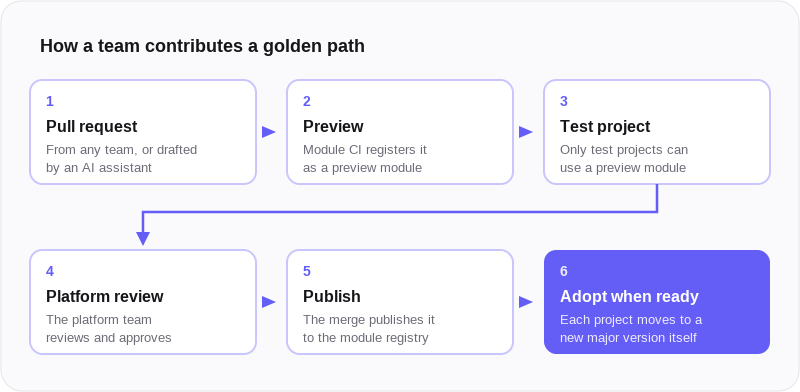
In the AI era, a contributor can also be an AI assistant. It can draft a new module from a plain-language request, and the same review, preview and rollout rules apply to its pull request as to a person's.
Facets and InnerSourcing
In Facets, every golden path is a module: Terraform with a contract around it that says what the module needs, what it gives and which few settings a developer can choose (modules and the catalog). The contract is what makes innersourcing safe. Any team can propose a module, and a machine checks every use of it against the contract. Standards belong in contracts that a machine can check, and design by contract explains the idea in depth. Here's how Facets puts the innersourcing principles into practice:
Provide Clarity on the Core and the Context:
Facets delivers clear guarantees by managing critical responsibilities like generating project-specific Infrastructure as Code (IaC), maintaining state, and running the same blueprint in every environment. At the same time, it avoids rigidity by offering guidelines for writing project-agnostic automation code rather than enforcing strict adherence to standard modules. This balance allows teams to innovate while relying on the platform's core strengths.
Open for Contributions:
Platform engineers and power developers can start from the modules in the Facets catalog, or wrap Terraform modules they already have, to create custom modules for their own use cases. These modules are published to the module registry, and Facets runs them in releases. Anything with a Terraform provider can become a module, so teams can bring their own cloud services and tools into the same blueprint.
Review & Preview Process:
Contributions are pull requests to the modules repo. Facets Module CI previews the module on each pull request and publishes it on merge (module CI). A preview module can only be used in a test project, so a new version is tested in isolation without disrupting ongoing operations. Today, AI can write the first draft of a module, and platform engineers test it on its own before any project uses it. Your AI assistant can build a module through Praxis, and its pull request goes through the same review.
Controlled Rollouts:
Modules are versioned. A breaking change is a new major version, and each project moves to it when it is ready (versioning strategy). This approach minimizes the blast radius of potential issues during module updates.
Building Transparency:
Transparency is built into the core of the Facets platform. Project owners can access details about the modules being used in their projects, view execution logs, and even examine the generated code. This visibility ensures developers and teams have a deep understanding of how the platform and its innersourced modules are functioning, fostering trust and collaboration.
Innersourcing changes who builds the platform, and contracts keep it safe. Platform teams write the rules. Everyone ships.
Conclusion
Innersourcing for platform engineering may not be a one-size-fits-all solution. For smaller organizations, a purely opinionated platform might suffice, offering simplicity and efficiency that aligns with their scale and needs. For larger enterprises and platforms built to last, innersourcing is a compelling avenue to explore. Collaboration, transparency and adaptability let platform engineers meet today's demands and keep the platform relevant as the organization changes.