


A developer needs a test environment for a new feature. The developer opens a ticket. The platform team is busy, so the ticket waits two days. Then someone asks which database version she needs, and it waits again. The code was ready on Monday. The environment arrives on Thursday.
Every engineering team knows this wait. A developer self-service platform exists to remove it.
Definition
Developer self-service platform
A developer self-service platform lets developers get what they need to ship, such as an environment, a database or a release, without a ticket. They ask for it themselves, and the platform delivers it inside rules that the platform team set once.
This post explains what developers self-serve and what the platform team keeps, why the usual ways to build self-service stall, and what changes now that AI assistants and agents ask for changes too.
What developer self-service means
Self-service moves the request from a person to a platform. The developer still asks. The platform answers, and it answers the same way every time.
That is the important part. Self-service keeps the rules. It moves them out of people's heads and into the platform, so the platform can apply them to every request.
Here is one rule in plain words: production databases must be encrypted, replicated and monitored. In a ticket queue, a reviewer remembers this rule, or forgets it. On a self-service platform, the rule lives inside the database building block. A developer who asks for a database gets one that is encrypted, replicated and monitored, with no extra step and no review comment.
So a self-service platform has two jobs:
- Say yes fast to the requests that fit the rules.
- Hold or stop the requests that need a person's judgment or break a rule.
A platform that does only the first job is a risk. A platform that does only the second is a ticket queue with a new screen.
What developers self-serve, and what the platform team keeps
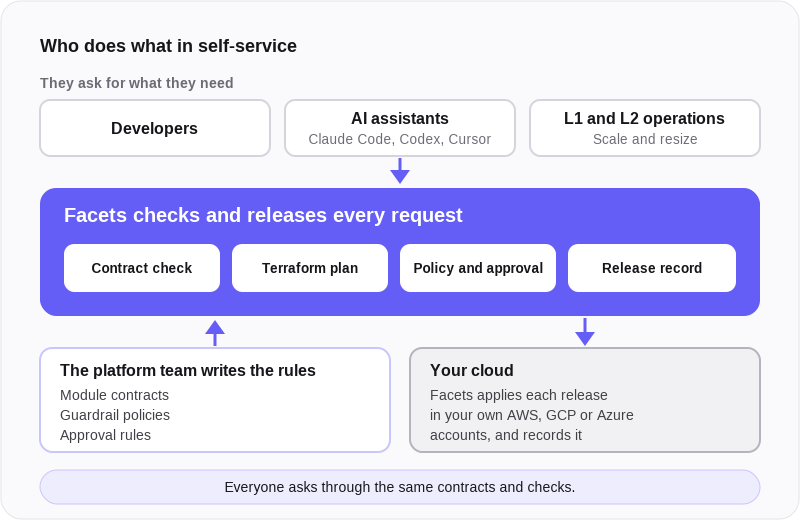
Self-service splits the work in two. Developers get the things they wait for most. The platform team keeps the things that must stay consistent.
| Developers self-serve | The platform team keeps |
|---|---|
| Environments for coding, testing and review | The standards inside each building block |
| App services: databases, queues, caches, storage | Guardrail policies for security, cost and compliance |
| Releases of their own services | Approval rules for the changes that need a person |
| Rollbacks when a release goes wrong | The cloud keys and the record of every change |
The split matters for operations teams too. An L1 or L2 engineer on call can scale an environment or resize a database during an incident, with the same building blocks and no more access than the task needs.
The usual ways to build self-service, and where they stall
Platform teams have tried to build self-service for years. Each approach helped. Each one also stopped short.
Templates copied once. The platform team writes a Terraform template, and each project copies it. The first copy is correct. Six months later there are forty copies, and each one has drifted from the template in a different way. A fix to the template reaches none of them.
Pipeline templates. The platform team writes a pipeline that builds, tests and deploys a service, and each project fills in the values. This works for the common case. Then a project needs a queue, a second region or a different database, and the request goes back to the platform team. Each new pipeline also runs with privileged access to the cloud, so only a few experts may change it.
Portals and catalogs. A portal such as Backstage or Port gives developers one place to find services, owners and docs, and a form to ask for a new resource. Portals are useful for discovery, and many teams keep one. But a portal is a front door. If the form behind it starts the same per-project pipelines, the privileged access and the review work stay underneath.
Even a well-run setup, with shared modules, a GitOps tool and templates where developers fill in values, still sends most changes to the platform team as a request. Why Facets describes this pattern in more detail. Each step added more pipelines to own, more privileged paths to secure and more reviews to do.
What AI changes
AI made writing code fast. A coding assistant writes a feature in an afternoon, and each engineer now sends more changes every week. Many of these changes need infrastructure: a new service, an environment for a branch, a cache, a schema.
The ticket queue does not grow with that volume. It moves at human speed, so the wait moves from writing code to shipping it.
AI also adds a new kind of requester. Developers now ask their AI assistant, such as Claude Code, Codex or Cursor, to make the infrastructure change too. An assistant can write Terraform that looks correct. The same Terraform can still fail when it applies, or skip a standard that exists only in a review comment. In code, a compiler and the tests catch the mistake in seconds. In infrastructure, nothing catches it before it reaches the cloud, except a person.
You cannot vibe code infrastructure.
So self-service in the AI era needs one more property. The platform must check every change before it runs, whoever sends it, and give a clear answer the requester can act on. Then a developer and an AI assistant can both self-serve, and the platform team does not review every line by hand.
Trust in agents also grows in steps. Most teams let an agent read and recommend first. They let it act with approval next, and act within policy only when the release history shows that a type of change is safe. Why Facets shows the controls at each step.
Self-service built on contracts
Self-service that scales to people and agents rests on three parts.
- Contracts. Each building block, such as a database or a Kubernetes cluster, is a versioned Terraform module with a contract around it. The contract says which few settings a developer can choose, what the module needs from other modules and what it gives back. The platform team decides the rest inside the module.
- One declared model. The developer states what the system needs in one model, the blueprint: the services, the databases, how they connect and where they run. Nobody writes the steps or a pipeline per project.
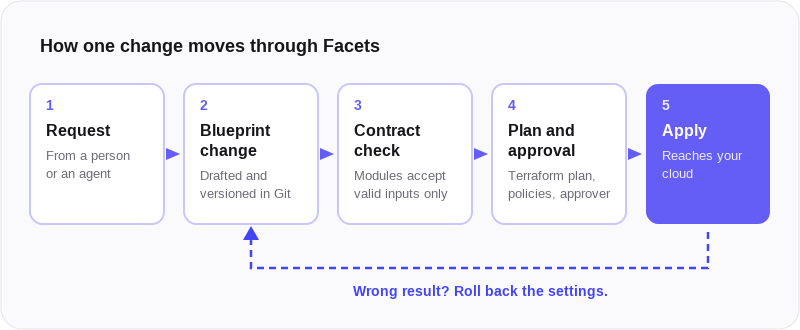
- Verify and release. Every change shows its plan first. Policies check it, and an approval rule holds it when a person must decide. Only then does it reach the cloud.
Facets is the infrastructure delivery platform for developers and their AI assistants. Each module is Terraform plus a contract that sets what developers can fill in, what the module needs and what it gives back. Developers fill in a form built from the contract, so they do not need to read the Terraform (Modules and the catalog).
Take one request: "Add a Postgres database to staging for the orders service." A developer asks for it in the web UI, or asks an AI assistant that works through the Praxis CLI. The database is added to the blueprint and connected to the service. The Postgres module checks the inputs against its contract. Facets shows the Terraform plan. Guardrail policies check the release, and if an approval rule applies to staging, the release waits for an approver. Then Facets applies it in the team's own cloud account, and the release history records what changed and who changed it.
The developer did not write Terraform, open a ticket or touch a pipeline. The platform team did no manual work, and its rules still applied. Approvals and guardrails gives the full rules, and Why Facets walks through the same change.
Because the rules live in versioned modules, they do not drift the way copied templates do. A new module version, such as support for a new Kubernetes version, is tested before any project uses it. Each project takes the new version when it is ready.
Here is how the three common requests compare:
| Request | Without self-service | With self-service on contracts |
|---|---|---|
| A new test environment | A ticket, then days of waiting for the platform team | The developer asks for an environment from the same blueprint as staging |
| A new service with a database | Network, database and pipeline set up by hand, then reviewed | The developer adds both to the blueprint, and the release checks and applies them |
| A database resize during an incident | An on-call engineer waits for someone with production access | The L2 engineer changes one setting, and the release goes through the same checks |
What the platform team gains
Self-service is often sold as a gift to developers. The platform team gains as much.
From tasks to rules. In a ticket model, the platform team spends its days on the same tasks: provision a server, set up a load balancer, open a firewall port, tune a database. With self-service on contracts, the platform team writes each rule once, inside a module or a policy. It reviews the rules, and the platform applies them to every change. When a change needs a review, the platform team approves or rejects it. It does not write the change again.
That frees time for the work only a platform team can do: a stronger security posture, cost and capacity planning, better building blocks, and help for the teams that need it.
Security by default. A rule in a document depends on someone reading it. A rule in a module applies every time. This is the move from security by audit to security by design. Every action also runs within the role of the person who starts it, from the web UI, the CLI or the API, so the audit trail shows who changed what and when.
Faster from merge to production. The wait after a merge is often the longest part of delivery. Self-service removes the queue for the changes that fit the rules, so the platform team's review time goes to the changes that need judgment.
One path for everyone. Developers, on-call engineers and AI assistants use the same building blocks and the same checks. There is no second path to secure for agents, and no privileged pipeline for incidents. Why Facets describes what changes for each group.
How to start with self-service
Most teams do not switch everything at once. A short path works better:
- Find the longest waits. Look at the last month of platform tickets. A few request types usually make up most of the queue: a new environment, a database, a change to a pipeline, an access request.
- Turn the most common request into a contract. Write the module for it, decide which few settings a developer may choose, and put the rest of the standard inside.
- Bring what already runs under the same model. Self-service that covers only new projects leaves the oldest, riskiest systems on the old path. Import them first, so every change after that goes through the same checks.
- Set approval rules where judgment matters. Production, deletions and critical resources are the usual places. Let everything else that fits the rules ship without a wait.
- Measure the wait. Track the time from a merged change to production, and the number of requests that still wait on the platform team. Both should fall.
Results teams see
Two customers show what self-service looks like when it works.
Niyo, a fintech with more than 160 engineers, runs its InfoSec rules as policy as code. 80% of Niyo's releases need no approval from DevOps or InfoSec.
Purplle grew its engineering team quickly and wanted developers to ship without waiting on DevOps. Purplle reached 100% developer autonomy on Facets.
Where to go next
Self-service is the goal. Contracts, one declared model and a check before every change are what make it safe at AI scale, for people and agents alike.
- For the mechanics of self-service provisioning and deployment, and the tools that offer it, read self-service infrastructure.
- To compare platforms, see the best internal developer platforms to consider.
- For the developer's side of the story, read developer experience and why it matters.
- To see how Facets supports developer self-service on your own stack, book a demo.