


Your engineering team ships code in hours. Your platform team is still stuck in a ticket queue.
Provisioning the infrastructure underneath it still takes weeks. Environments take weeks to spin up. Terraform modules get copy-pasted across teams with zero consistency. And when someone tries a general-purpose LLM to generate infra code, it looks right, then it blows up on apply.
This problem is significant enough that Gartner® now recognizes it across a dedicated Market Guide and cites it inside five different 2026 Hype Cycles. Facets Cloud, and our AI product Praxis (listed by Gartner as Facets Intelligence), is named in all of them. Industry recognition lists every Gartner mention.
The Recognition
In March 2026, Gartner® published its inaugural Market Guide for AI Assistants for Infrastructure as Code, naming Facets Cloud a Representative Vendor with Praxis on the list.
"By 2029, 90% of I&O organizations will have integrated context-aware AI assistants into their IaC workflows to bridge specialized cloud-native skill shortages compared to 5% in 2026."
— Source: Gartner®, Market Guide for AI Assistants for Infrastructure as Code, 27 March 2026
Since then, the same AI Assistants for Infrastructure as Code technology profile, and Facets Cloud's Sample Vendor listing in it, has been cross-referenced into four more 2026 Hype Cycles: Site Reliability Engineering, AI and Cloud Platform Services, Infrastructure Strategy, and Infrastructure Platforms (plus an adjacent citation in the Hype Cycle for Human and Social Services in Government). Going from a single Market Guide to five citations in one year is the strongest signal yet that this category has moved from niche to expected.
Why This Category Exists Now
Three things are driving this market.
1. Generic LLMs aren't enough
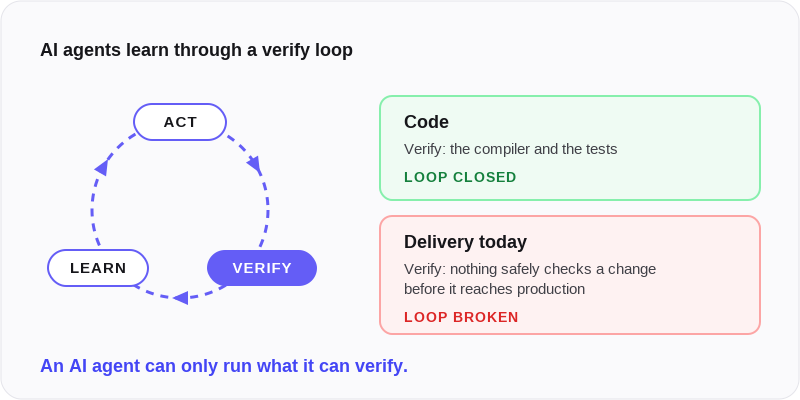
General-purpose AI writes Terraform that looks right. It does not know how your system is wired: your networks, your naming, your policies. So the code fails on apply, or it skips a standard that lives only in a review comment. Code has a compiler and tests to catch this. Infrastructure delivery has no such check, so an assistant needs the system's model for context and a check before every change. Why Facets explains why this check is what lets AI move from assisted to autonomous in delivery.
2. Day 2 is the real problem
Most IaC tools nail Day 1 (spinning something up). Day 2 is where things fall apart: drift, cost creep, compliance gaps. That needs AI that stays in the loop after the first apply. A one-shot code generator stops too early.
3. The market is moving to agentic AI
We're past "ask me and I'll suggest something" assistants. Next: agents that plan, execute, and fix things on their own, inside guardrails you set.
Where Facets Fits In
Here's how Praxis delivers on what this market demands.
- Grounded in your real system. Your AI assistant works through the Praxis CLI against your projects, blueprints and Infrastructure Graph, so its changes start from what runs today.
- Day 2 changes go through the same release. When an environment drifts, a release with Refresh finds the change and brings it back to the blueprint, with the same contracts, checks and approvals.
- Policy-as-code guardrails. Platform teams define guardrails upfront through Contracts, hard boundaries enforced at plan time. If it doesn't comply, it doesn't deploy.
- Zero lock-in. The Market Guide recommends evaluating exit viability and avoiding vendor lock-in. Everything Facets generates is standard Terraform and Helm, and an Export Terraform release gives you any environment's Terraform and modules (How Facets works).
How the Blueprint Model Works
Most AI-for-IaC tools bolt a copilot onto existing HCL files. Facets works in four layers instead:
| Layer | What happens |
|---|---|
| 1. Contracts | AI agents author focused, reusable Terraform modules; platform engineers review, set guardrail policies in Rego, the Open Policy Agent language, and seal the contract as an enforceable boundary. |
| 2. Blueprints | Developers compose environments (compute, database, network, security) from their AI assistant or the web UI, with no HCL to write, and guardrails inherited automatically. |
| 3. Orchestration | Facets generates Terraform, configures Helm charts, deploys the images your CI builds, and wires each module's outputs to the next module's inputs, deterministically, from validated contracts. |
| 4. Verify and release | Every change shows its Terraform plan, passes guardrail policies and waits for approval where a rule applies. Only the Facets orchestrator applies it, and it holds the cloud keys. |
Developers and AI agents operate at the same level throughout: they declare the intent, and Facets handles the implementation.
Results in Production
| Customer | Before Facets | After Facets |
|---|---|---|
| Niyo (fintech, 160+ engineers) | A lean DevOps team built for 10 engineers, serving 100+ | ~2,000/month, 80% of releases need no DevOps or InfoSec approval |
| Capillary (retail CRM, 250+ brands) | A growing dependency on the ops team, with ticket delays and burnout | 95% reduction in ops tickets, 20% developer productivity gain |
| Purplle (e-commerce) | DevOps bottlenecks as the team grew from 20 to 120 engineers | 100% developer self-service, 70% non-production cost reduction |
"Tasks that needed ops oversight are now self-served. Facets gives developers complete freedom while keeping ops in control."
"
Piyush K, CTO, Capillary Technologies
Citation History
| Report | Recognition | Analysts | Publication Date |
|---|---|---|---|
| Market Guide for AI Assistants for Infrastructure as Code | Representative Vendor (Facets Intelligence) | Hassan Ennaciri, Daniel Betts, Chris Saunderson, Owen Marino | 27 March 2026 |
| Gartner® Hype Cycle™ for Site Reliability Engineering, 2026 | Sample Vendor | Hassan Ennaciri, Daniel Betts, Chris Saunderson, Paul Wang | 26 May 2026 |
| Hype Cycle for Human and Social Services in Government, 2026 | Sample Vendor | Roland Rivera | 8 June 2026 |
| Hype Cycle for AI and Cloud Platform Services, 2026 | Sample Vendor | Prasanna Lakshmi Narasimha, Tigran Egiazarov | 15 June 2026 |
| Hype Cycle for Infrastructure Strategy, 2026 | Sample Vendor | Ashish Banerjee, Alessandro Galimberti | 15 June 2026 |
| Hype Cycle for Infrastructure Platforms, 2026 | Sample Vendor | Dennis Smith | 25 June 2026 |
This page is updated in place as new reports cite this category, rather than superseded by a new dated post each year. Gartner also recognizes Facets for self-service environment management, infrastructure automation and orchestration and infrastructure platform engineering.
Book a 30-min architecture review →
Gartner Disclaimer
GARTNER is a registered trademark and service mark of Gartner, Inc. and/or its affiliates in the U.S. and internationally, and HYPE CYCLE is a registered trademark of Gartner, Inc. and/or its affiliates and are used herein with permission. All rights reserved.
Gartner® does not endorse any company, vendor, product or service depicted in its publications, and does not advise technology users to select only those vendors with the highest ratings or other designation. Gartner® publications consist of the opinions of Gartner's research organization and should not be construed as statements of fact. Gartner® disclaims all warranties, expressed or implied, with respect to this publication, including any warranties of merchantability or fitness for a particular purpose.