


The moment
In 2023, a tax change hit MPL's margins, and the AWS bill was one of its largest costs. MPL had already cut that bill by more than half on its own, so the next step was a new cloud. The move had to happen while 100+ engineers kept shipping features. And every release still needed a developer, a QA engineer and an SRE on the same call.
“...a 30 minute to 1 hour outage ends up costing us millions of dollars in GMV. So we cannot afford any downtimes.”
 Kaustubh BhoyarSVP Engineering, MPL
Before: how work flowed
Before the move, every release and every test environment went through the SRE team.
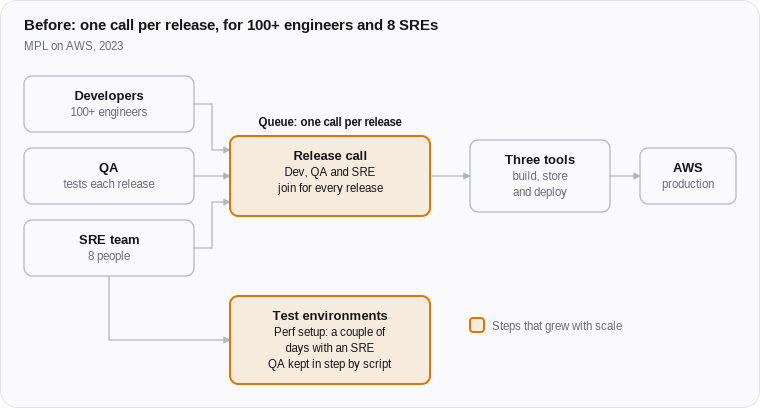
- Every release needed a call. Each release brought a developer, a QA engineer and an SRE together on a call. With 100+ engineers and eight SREs, release calls took a growing share of SRE time. At one point MPL cut releases to once in two weeks, then once a week.
- Three tools for one release. Build, store and deploy each ran in a different system, on top of Terraform and Ansible.
- A large estate to map. MPL had grown to 100 to 130 services, and some of their authors had moved on.
- Test environments cost days. A performance environment took a couple of days of setup and teardown, with an SRE involved. Keeping QA in step with production took a custom script that compared service versions.
What they tried first
MPL had already moved one system to Google Cloud with a migration partner, the usual route for a move like this:
“...we migrated our data warehouse from AWS to GCP and there we were using a third party partner recommended by GCP for migration, and that migration took us over a year, almost...”
Kaustubh BhoyarSVP Engineering, MPLMPL also ruled out a one-shot cutover: with so many services, it would cost more in parallel infrastructure and pull every developer off feature work.
Why Facets
MPL wanted the move to fix delivery too: fewer tools, no SRE on release calls, and a service move that developers could make themselves with one configuration change. A tight deadline and a small SRE team settled the build-or-buy question.
“...we can write our own Terraform code to manage everything. Obviously we can. But... we would never be able to do justice through that Terraform code because we have a small SRE team. And if the tool for doing that is available in market, why do you want to build it in-house?”
Kaustubh BhoyarSVP Engineering, MPLHow it worked
Developers moved their own services at their own pace, one island at a time, with no downtime while feature work went on; any service could go back to AWS with the same switch.
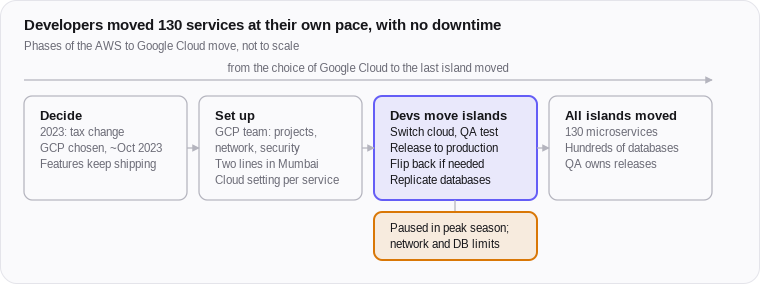
MPL's SRE team set up the platform once; after that, developers moved their services on their own.
- Developers moved their own services. Each service in Facets had a cloud setting, its flavor: AWS or GCP. A developer changed it, deployed to QA on Google Cloud, tested and released to production. Kaustubh: it "reduced the developer involvement by a lot."
- Islands, not single services. Services that talk mostly to each other moved together; payments, about 10 services, was one island. A low-latency link between AWS and Google Cloud in Mumbai let a moved service still use a database on AWS.
- Databases by risk. MPL's central team moved the databases separately, most through live replication and the most critical in one short planned window.
- One standard, both clouds. The SRE team ran the ingress on AWS and Google Cloud from the same service definitions in Facets. Google Cloud's team set up projects and the network.
The technical story is in How MPL migrated 130 services from AWS to GCP.
After: how work flows now
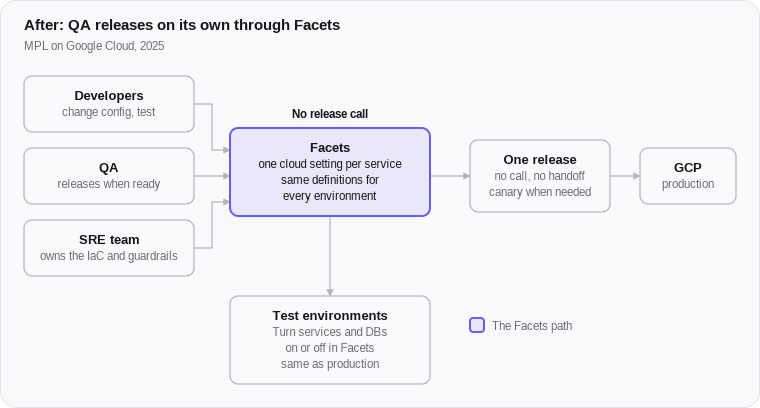
QA now decides when a service is ready and releases it from Facets, with no release call, and MPL has since added canary releases. The SRE team owns the IaC as well as the guardrails, set once for every service, and now works on reliability. A new performance or QA environment comes from the same definitions as production: the team turns services and databases on or off in Facets. Almost all infrastructure, except game servers on virtual machines, now sits in one place.
Results
| Result | What made it possible |
|---|---|
| 130 servicesmoved self-service by MPL's own developers, at their own pace and with zero downtime | One cloud setting, a QA test and a release per service |
| 8xdeployment frequency, from 1 to 8 releases per week | QA releases on its own, with no release call |
| 20% savedon cloud costs | All infrastructure in one place, with one standard for every service |
| Days to a toggleto launch a production-like test environment | Every environment comes from the same definitions as production |
In their words
“We had to just change this one flavor setting from AWS service to GCP service and do a release, and service would become available in QE environment on GCP.”
Kaustubh BhoyarSVP Engineering, MPL“...we ended up achieving all the goals of migration... we are now doing more releases with more confidence...”
Kaustubh BhoyarSVP Engineering, MPLWhat's next
In February 2025, MPL's SRE team was building a new observability platform. With all infrastructure in one place, MPL can now say how long a future move would take and make it with much more confidence.
The idea this story proves
MPL's 8-person SRE team set up the platform once: a cloud setting per service, the same definitions for every environment. Developers then moved their own services, and QA released on its own, inside those rules. That is the idea behind Platform teams write the rules. Everyone ships.