


The moment
For seven years, Treebo built almost all its technology in house, and all of it ran in India. Part of the infrastructure was set up by hand and part by scripts, which worked well for one region. Then Hotel Superhero signed an international client, and Treebo had to build a setup in Africa. There was no way to copy the India setup exactly. At the same time, as the business grew, production support took most of the DevOps team's days.
“The biggest challenge for the DevOps team was that they would spend good 70, 80% of their time in solving production issues or helping the development teams out in debugging ...”
 Kadam Jeet JainCo-Founder and CTO, Treebo Hotels and Hotel Superhero
Before: how work flowed
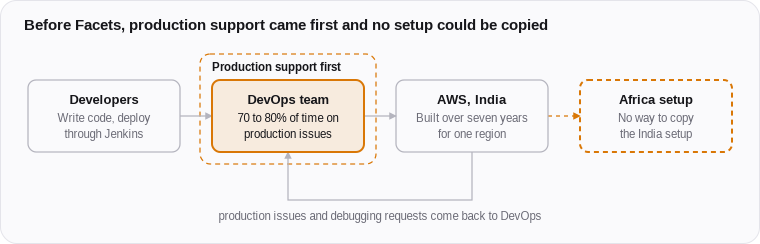
- Production support first. Production issues and debugging help took 70 to 80% of DevOps time, so every other request waited longer.
- No single source for operations. Many alerts were set one by one in CloudWatch, with no one place to change them.
- Setups that drift. Part of the stack was set up by hand, which worked for one region; over time staging and production drifted apart, and a new region could not be built the same way.
- Pipelines doing two jobs. Jenkins ran both CI and CD, so each pipeline carried both jobs and grew complex.
- A setup for each tenant. Each new Hotel Superhero tenant needed its own workers, queues and schemas, so the work grew with every tenant signed.
What they tried first
Treebo had a strong build-in-house culture. It had its own infrastructure automation and workflow tools, good CI and CD pipelines on Jenkins, and its own logging stack. Deployments were safe, and these tools served Treebo well in one region; as the business grew, running them took a growing share of the teams' time. The DevOps team had also started to explore Kubernetes on the side and wanted to run it in production.
Why Facets
Treebo would need many production clusters, and Kadam put the bar plainly: "it's mission critical for the success of the business itself that each production cluster has identical specs."
Treebo had two concerns. Would Treebo build a strong dependency on Facets? And would Facets pre-solve every problem and leave the DevOps team, keen to run Kubernetes in production, nothing to learn? Both concerns went away as the team worked with the platform. Facets runs on Kubernetes, so the team could still work directly with servers and pods and build on top of it.
“As we built familiarity with Facets, the concerns were mitigated. Since Facets is built over standard offerings like Terraform, we can still build much more on top of it! The combination works really well. Facets is only making it simpler which otherwise would need 3X more time and resources. With instances of co-architecting and problem-solving, our team developed faith in the product and the team.”
Kadam Jeet JainCo-Founder and CTO, Treebo Hotels and Hotel SuperheroHow it worked
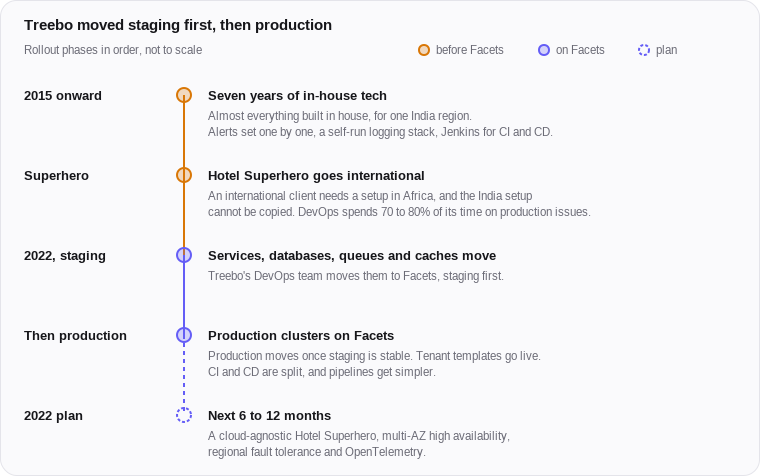
Staging, then production. Treebo's DevOps team moved all its services, databases, queues and caches to Facets, staging first. Once staging was stable and the team knew the product, production followed.
One standard, all as code. Treebo's DevOps team owns the IaC: alerting, monitoring, deployment and infrastructure creation are all defined as code in Facets. No part of the stack is created by hand, so staging and every production cluster come out the same. Any environment can be spun up or terminated with a single click, which made new regions simpler to add.
Tenants from templates. When Hotel Superhero creates a tenant, the templates start what it needs: a message queue, database schemas and tenant-specific workers. Other tenants are not affected.
CI and CD split. Treebo's team kept Jenkins for CI only and moved deployment to Facets. The pipelines became simpler, easier to maintain and faster.
One dashboard for operations. Treebo's SRE and operations teams deploy, roll back, track metrics and scale services from the Facets dashboard, with no server logins.
After: how work flows now
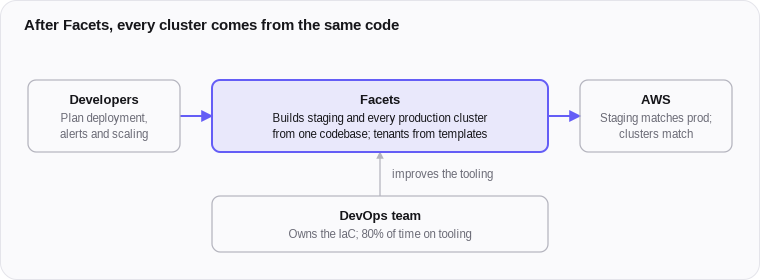
Every environment now comes from the same code, so when production breaks, the team knows the cause is in the code and not in an infrastructure difference. The DevOps team owns the IaC and spends most of its time on tooling, guidelines and research for developers.
Results
| Result | What made it possible |
|---|---|
| 70% fewerproduction issues | Staging and every production cluster come from the same code |
| 80%of DevOps time now goes to tooling, guidelines and research | Fewer production issues and no infrastructure built by hand |
| 50% lesstime to deploy | Jenkins does only CI, and Facets handles deployment |
| Days to minutesfor tenant onboarding | Templates create each tenant's queue, schemas and workers |
In their words
“With Facets we have true infrastructure-as-code including alerting, monitoring, deployment and infrastructure creation. Our Staging environments now look identical to Production environments and we now have multiple production clusters which in turn look similar. This is a big win for us!”
Kadam Jeet JainCo-Founder and CTO, Treebo Hotels and Hotel Superhero“Earlier the development teams were only worried about their code. Facets have created awareness for Developers - I can already see developers now aware of, How will my code be deployed? What kind of infrastructure does it need? What kind of alerting needs to be set up? What kind of autoscaling is needed?”
Kadam Jeet JainCo-Founder and CTO, Treebo Hotels and Hotel SuperheroWhat's next
In 2022, Treebo planned to make Hotel Superhero cloud agnostic within 6 to 12 months, so a client could ask for AWS, GCP or Azure. Next on the list were a multi-AZ high-availability setup, regional fault tolerance and OpenTelemetry.
The idea this story proves
Treebo's win was simple to state: staging and every production cluster come from one model, so they cannot drift apart, and a new region or a new tenant is a request instead of a project. Facets calls this environments as a commodity.